
Sign up for our newsletter
Subscribe to our emails

Skull is the quintessence of bluffing, a game in which everything is played in the players' heads. Each player plays a face-down card, then each player in turn adds one more card – until someone feels safe enough to state that he can turn a number of cards face up and get only roses. Other players can then overbid him, saying they can turn even more cards face up. The highest bidder must then turn that number of cards face up, starting with his own. If he shows only roses, he wins; if he reveals a skull, he loses, placing one of his cards out of play. Two successful challenges wins the game. Skull & Roses is not a game of luck; it's a game of poker face and meeting eyes.
£19.00 £17.10
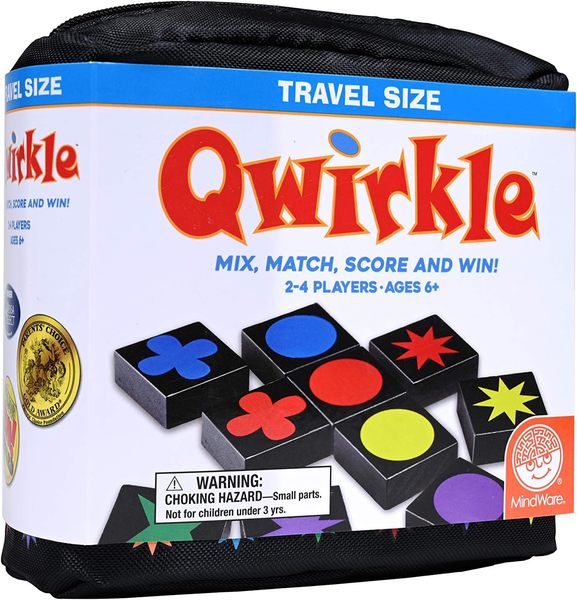
This travel edition of the game is stored in a small nylon bag.The abstract game of Qwirkle consists of 108 wooden blocks with six different shapes in six different colors. There is no board, players simply use an available flat surface.Players begin the game with six blocks. The start player places blocks of a single matching attribute (color or shape but not both) on the table. Thereafter, a player adds blocks adjacent to at least one previously played block. The blocks must all be played in a line and match, without duplicates, either the color or shape of the previous block.Players score one point for each block played plus all blocks adjacent. It is possible for a block to score in more than one direction. If a player completes a line containing all six shapes or colors, an additional six points are scored. The player then refills his hand to six blocks.The game ends when the draw bag is depleted and one player plays all of his remaining blocks, earning a six point bonus. The player with the high score wins.
£16.00 £14.40
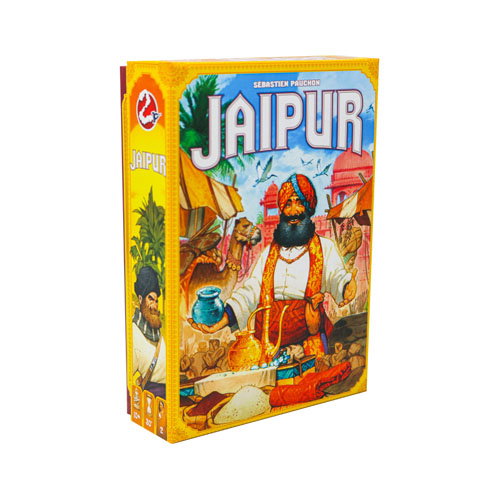
You are one of the two most powerful traders in the city of Jaipur, the capital of Rajasthan, but that's not enough for you because only the merchant with two "seals of excellence" will have the privilege of being invited to the Maharaja's court. You are therefore going to have to do better than your direct competitor by buying, exchanging, and selling at better prices, all while keeping an eye on both your camel herds.Jaipur is a fast-paced card game, a blend of tactics, risk and luck. On your turn, you can either take or sell cards. If you take cards, you have to choose between taking all the camels, taking one card from the market, or swapping 2-5 cards between the market and your cards.If you sell cards, you get to sell only one type of good, and you receive as many chips for that good as the number of cards you sold. The chips' values decrease as the game progresses, so you'd better hurry! On the other hand, you receive increasingly high rewards for selling three, four, or five cards of the same good at a time, so you'd better wait!You can't sell camels, but they're paramount for trading and they're also worth a little something at the end of the round, enough sometimes to secure the win, so you have to use them smartly.
£20.00 £18.00
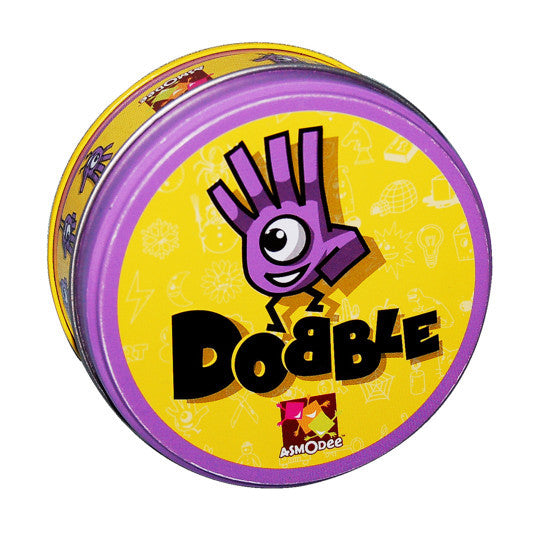
Dobble, is a simple pattern recognition game in which players try to find an image shown on two cards.Each card in original Spot it! features eight different symbols, with the symbols varying in size from one card to the next. Any two cards have exactly one symbol in common. For the basic Spot it! game, reveal one card, then another. Whoever spots the symbol in common on both cards claims the first card, then another card is revealed for players to search, and so on. Whoever has collected the most cards when the 55-card deck runs out wins!
£13.99 £12.60

The Lord of the Rings: Duel for Middle-Earth – Allies features various characters from J.R.R. Tolkien's universe who will come to the aid of either the Fellowship or Sauron. Collect power tokens in each chapter and use them to call upon your allies and benefit from their effects
£8.00 £7.20
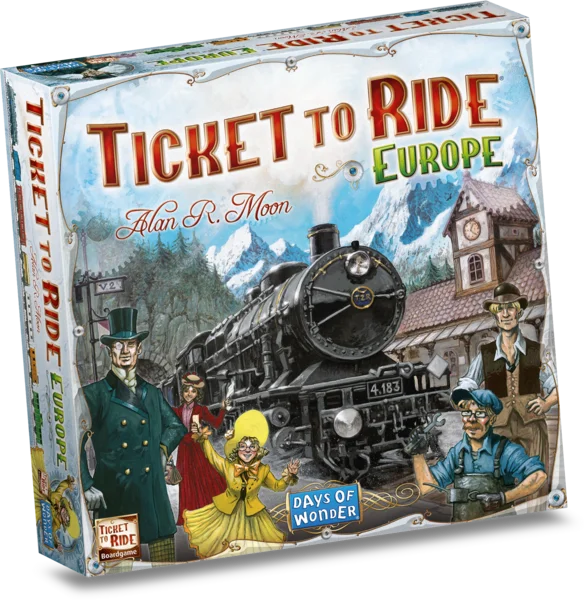
Ticket to Ride: Europe takes you on a new train adventure across Europe. From Edinburgh to Constantinople and from Lisbon to Moscow, you'll visit great cities of turn-of-the-century Europe. Like the original Ticket to Ride, the game remains elegantly simple, can be learned in 5 minutes, and appeals to both families and experienced gamers. Ticket to Ride: Europe is a complete, new game and does not require the original version.More than just a new map, Ticket to Ride: Europe features brand new gameplay elements. Tunnels may require you to pay extra cards to build on them, Ferries require locomotive cards in order to claim them, and Stations allow you to sacrifice a few points in order to use an opponent's route to connect yours. The game also includes larger format cards and Train Station game pieces.The overall goal remains the same: collect and play train cards in order to place your pieces on the board, attempting to connect cities on your ticket cards. Points are earned both from placing trains and completing tickets but uncompleted tickets lose you points. The player who has the most points at the end of the game wins.Part of the Ticket to Ride series.
£44.99 £40.50
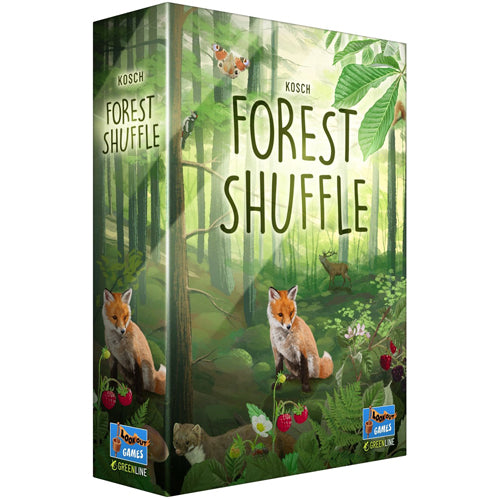
In Forest Shuffle, players compete to gather the most valuable trees, then attract species to these trees, thus creating an ecologically balanced habitat for flora and fauna.To start, each player has six cards in hand, with cards depicting either a particular type of tree or two forest dwellers (animal, plant, mushroom, etc.), with these latter cards being divided in half, whether vertically or horizontally, with one dweller in each card half.On a turn, either draw two cards — whether face down from the deck or face up from the clearing — and add them to your hand, or play a card from your hand by paying the cost, then putting it into play.Each tree and dweller shows a cost, and to pay this cost, you must discard cards from your hand into the clearing face up. If you play a tree, flip the top card of the deck into the clearing, then place the tree in front of you. If you play a dweller, pay only the cost on the dweller you choose, then slide this card under a tree that has an empty side that matches the dweller you want to play. (A tree can have cards played on all four sides of it: top, bottom, left, and right.)Alternatively, you can play a card face down as a tree sapling. This card costs nothing and can have dwellers played on it, but it has no species, whereas each tree is one of eight species.After you play a card, you can use the effect on this card (drawing cards, placing additional cards, taking another turn, etc.) or gain the bonus you gained if you paid for this card with cards of the same color — or both, if applicable, with the effect taking place before the bonus.If at the end of your turn the clearing contains more than nine cards, place all of these cards in the box out of play.During set-up, three winter cards were placed into the bottom third of the deck. When the third winter card is drawn, the game ends immediately, then players tally their points based on the trees and dwellers in their forest. Whoever scores the most points wins.Forest Shuffle is the first in a line of Lookout games sporting the Lookout Greenline label, produced on FSC certified paper and avoiding plastic completely.
£26.99 £24.30
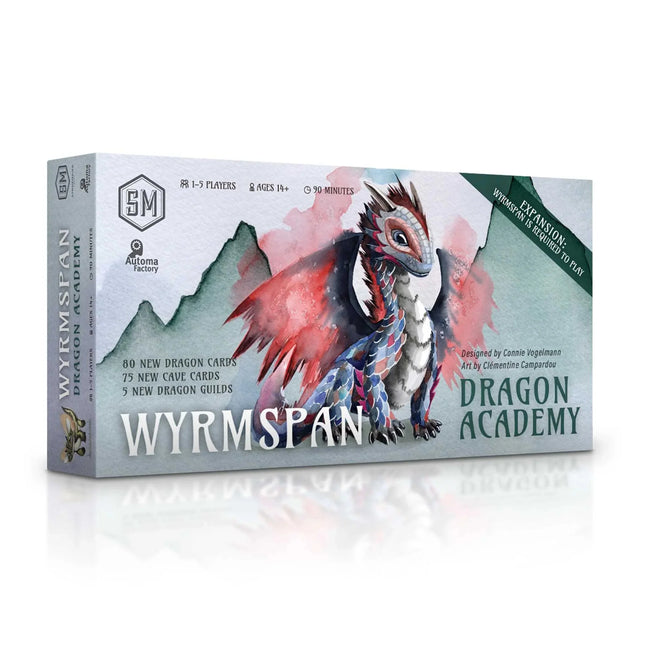
As a budding dracologist, you open an academy for fledgling dragons to achieve their full potential! The expansion to Wyrmspan adds a wide variety of new dragons and caves, objective tiles, dragon guilds, and a new round tracker that presents you with an income choice when you pass for the round. Welcome to Wyrmspan: Dragon Academy, designed by Connie Vogelmann and illustrated by Clémentine Campardou! —description from the publisher
£27.99 £24.20
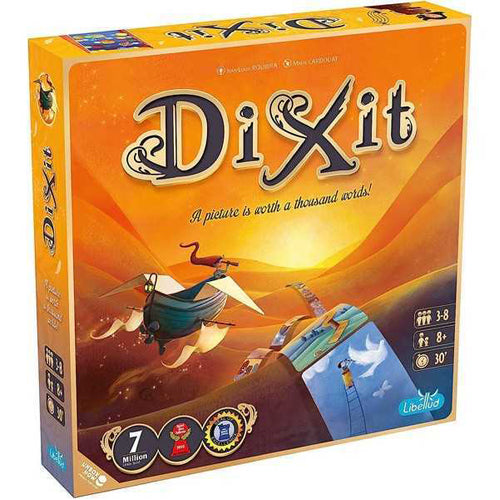
2010 Spiel des Jahres WinnerOne player is the storyteller for the turn and looks at the images on the 6 cards in her hand. From one of these, she makes up a sentence and says it out loud (without showing the card to the other players).Each other player selects the card in their hands which best matches the sentence and gives the selected card to the storyteller, without showing it to the others.The storyteller shuffles her card with all the received cards. All pictures are shown face up and every player has to bet upon which picture was the storyteller's.If nobody or everybody finds the correct card, the storyteller scores 0, and each of the other players scores 2. Otherwise the storyteller and whoever found the correct answer score 3. Players score 1 point for every vote for their own card.The game ends when the deck is empty or if a player scores 30 points. In either case, the player with the most points wins the game.The base game and all expansions have 84 cards each.
£29.99 £27.00
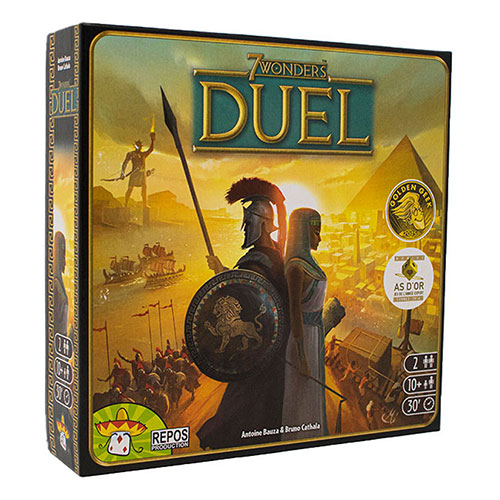
In many ways 7 Wonders Duel resembles its parent game 7 Wonders as over three ages players acquire cards that provide resources or advance their military or scientific development in order to develop a civilization and complete wonders.What's different about 7 Wonders Duel is that, as the title suggests, the game is solely for two players, with the players not drafting cards simultaneously from hands of cards, but from a display of face-down and face-up cards arranged at the start of a round. A player can take a card only if it's not covered by any others, so timing comes into play as well as bonus moves that allow you to take a second card immediately. As in the original game, each card that you acquire can be built, discarded for coins, or used to construct a wonder.Each player starts with four wonder cards, and the construction of a wonder provides its owner with a special ability. Only seven wonders can be built, though, so one player will end up short.Players can purchase resources at any time from the bank, or they can gain cards during the game that provide them with resources for future building; as you acquire resources, the cost for those particular resources increases for your opponent, representing your dominance in this area.A player can win 7 Wonders Duel in one of three ways: each time you acquire a military card, you advance the military marker toward your opponent's capital, giving you a bonus at certain positions; if you reach the opponent's capital, you win the game immediately; similarly, if you acquire any six of seven different scientific symbols, you achieve scientific dominance and win immediately; if none of these situations occurs, then the player with the most points at the end of the game wins.
£24.99 £22.50
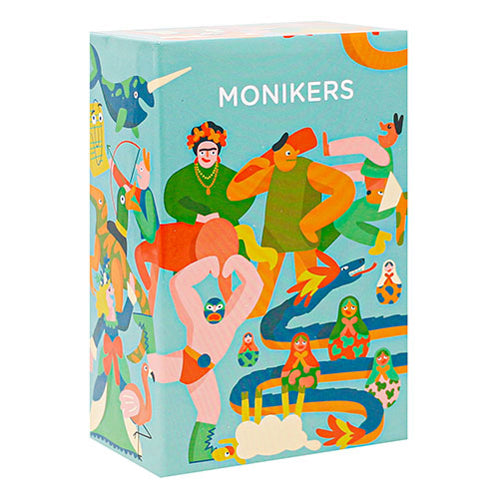
Monikers is a party game based on the public domain game Celebrity, where players take turns attempting to get their teammates to guess names by describing or imitating well-known people.In the first round, clue givers can say anything they want, except for the name itself. For the second round, clue givers can only say one word. And in the final round, clue givers can’t say anything at all: they can only use gestures and charades.
£30.00 £27.00
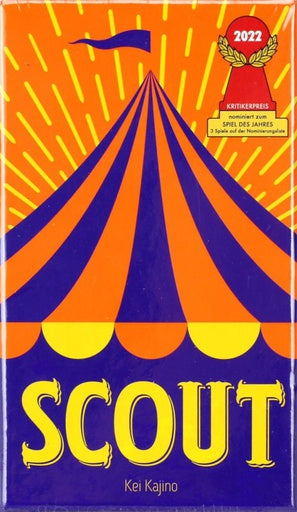
SCOUT is a ladder-climbing game in which cards have two potential values, players may not rearrange their hand of cards, and players may pass their turn to take a card from the current high set of cards into their hand. More specifically, cards are dual-indexed, with different values on each half of the card, with the 45 cards having all possible combinations of the numbers 1-10. During set-up, whoever is shuffling the cards should randomize both the order of the cards in the deck and their orientation. Once each player has been dealt their entire hand of cards, they pick up that hand without rearranging any of the cards; if they wish, they can rotate their entire hand of cards in order to use the values on the other end of each card, but again they cannot rearrange the order of cards in their hand. On a turn, a player takes one of two actions: • Play: A player chooses one or more adjacent cards in their hand that have all the same value or that have values in consecutive order (whether ascending or descending), then they play this set of cards to the table. They can do this only if the table is empty (as on the first turn) or the set they're playing is ranked higher than the set currently on the table; a set is higher if it has more cards or has cards of the same value instead of consecutive cards or has a set of the same quantity and type but with higher values. In this latter case when a player overplays another set, the player captures the cards in this previous set and places them face down in front of themselves. • Scout: A player takes a card from either end of the set currently on the table and places it anywhere they wish in their hand in either orientation. Whoever played this previous set receives a 1 VP token as a reward for playing a set that wasn't beaten. Once per round, a player can scout, then immediately play. When a player has emptied their hand of cards or all but one player have scouted instead of playing, the round ends. Players receive 1 VP for each face-down card, then subtract one point for each card in their hand (except if they were the player scouted repeatedly to end the game). Play as many rounds as the number of players, then whoever has the most points wins.
£20.00 £18.00
Subscribe to our emails