
Sign up for our newsletter
Subscribe to our emails

Terrinoth is in peril. The demon-tainted Uthuk Y'llan barbarians stalk the realm and the undead servants of Waiqar the Undying venture beyond their borders for the first time in memory. The leaders of Terrinoth are divided and fractious, unable to unite against these common threats. And in the northern barony of Forthyn, the stage is set for the next great confrontation between Terrinoth and the forces of darkness...For years, your journeys have taken you across the fantasy realm of Terrinoth, venturing into dark forests, shadowy cities, ancient crypts, and misty swamps — but your true legend is about to begin.Forge your own legend together with friends as you adventure across the vibrant fantasy realm of Terrinoth in the co-operative dungeon-crawling board game Descent: Legends of the Dark. Powered by an integrated free companion app, Descent: Legends of the Dark puts you in the role of a budding hero with their own playstyle and abilities. Together with your unlikely companions, you'll begin an unexpected adventure — an adventure told across the sixteen quests of the "Blood and Flame" campaign. Throughout your campaign, you'll face undead lurking in the mists, demonic barbarians stalking the wilds, and even more terrifying threats. With 46 pieces of 3D terrain and forty hero and monster miniatures to draw you into the game, your greatest adventure is yet before you! Your objectives will change from quest to quest as you follow the overarching story of the campaign.Core gameplay mechanisms such as combat, fatigue, skills, items, and more have received completely new interpretations with Legends of the Dark, while a new approach to scenario layout and 3D terrain creates striking multi-level scenarios.Gameplay is fast and intuitive. You take three actions each turn: one maneuver action and two additional actions of your choice. Maneuvering gives you movement points, as shown in the upper right corner of the character sheet, and since you always have a maneuver action, you can reposition to put yourself in a more advantageous position for attack. Other than maneuvering, you can use an action to attack an enemy, rolling your attack dice and drawing upon your hero's abilities and weapons to deal maximum damage or inflict harmful conditions on your foes, or you may use the explore action to interact with a piece of 3D terrain or a token by using the app. You can also use your action to perform one of the most crucial actions in Legends of the Dark: the ready action, which lets you flip your hero sheet or one of your cards to its opposite side, unlocking new abilities!Your hero sheet isn't the only thing you can ready. Every hero also has an attack card and skill cards! Each hero starts the game with two weapon cards, which are sleeved together back-to-back to create a single attack card. Skill cards can also be readied, switching between two complementary abilities.The app also brings new changes to gameplay, introducing enemies with adaptable strategies, complex status effects, and triggers fully managed by the app, and the ability to develop your heroes based on the choices you make in scenarios. You'll also uncover a wealth of activity between scenarios, such as crafting, shopping in the city, upgrading equipment, and more. Because of these various differences, Descent: Legends of the Dark is not compatible with Descent: Journeys in the Dark and its expansions.—description from the publisher
£175.00 £125.00

Two players battle for control over the lush life-sustaining sanctuaries of the desert. By cleverly playing and grouping animal cards, players can show their strength, unlock powers, and use palm tree tokens to alter values. Do you have what it takes to survive in the Desperate Oasis? I don't. Desperate Oasis is a small "lane-battling" card game where you will play Animal Cards on your side (and sometimes your opponent's side) of a row of Oasis Cards in an attempt to win them. Special spatial rules pull similar animals together, allowing for manipulation of card positions. Each animal has a special power that can be triggered to alter the outcome of each duel, some only being revealed at the end of the round. —description from the designer
£11.99 £10.80
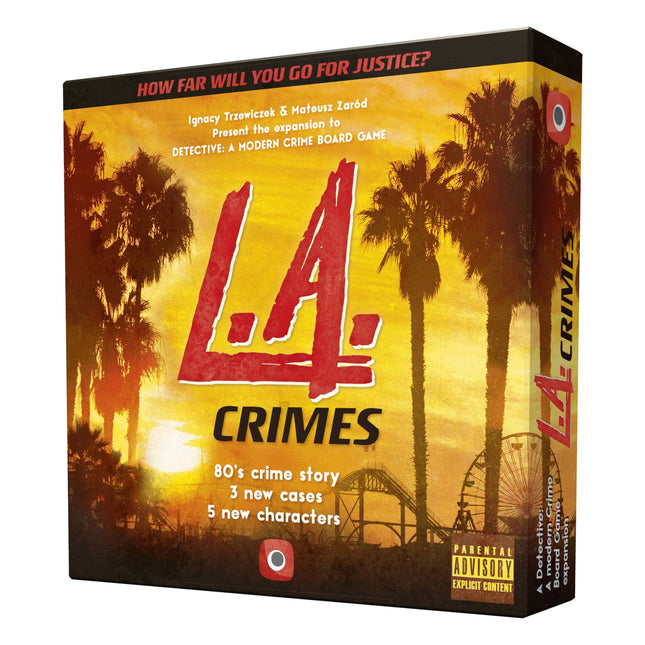
Detective: L.A. Crimes, the first campaign expansion for Detective: A Modern Crime Board Game, consists of three separate cases that come together to form a full story. Travel to sunny California, and delve deep into the drug-filled Los Angeles of the 1980s. Experience being an L.A. detective, and realize that sometimes, like detective Foley from Beverly Hills Cop, you may need to stretch the laws a bit to suit your needs. Try some controversial methods to solve your case, all the while battling with the red tape of bureaucracy. Use all-new mechanisms of stakeout and observation to learn more about your suspects. The choices are yours, but are you willing to cross the line?
£26.99 £18.90
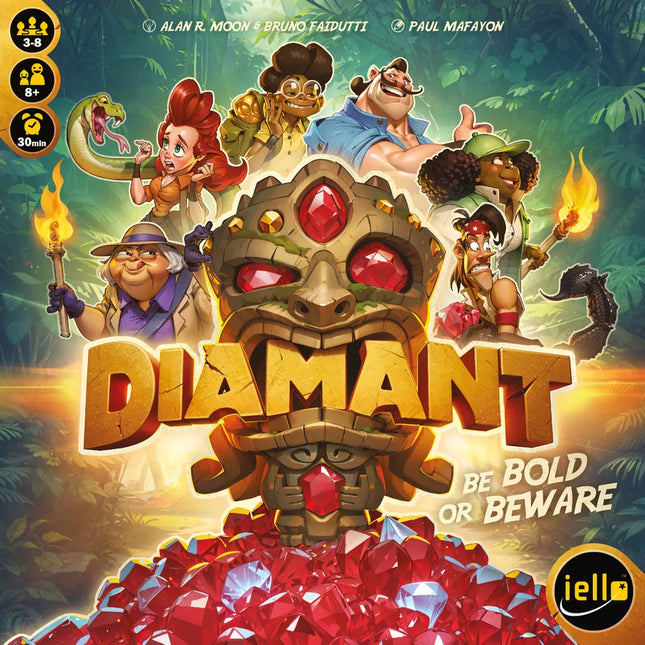
Diamant — also published as Incan Gold — is a quick, fun, press-your-luck game. Players venture down mine shafts or explore paths in the jungle by turning up cards from a deck and evenly sharing the gems they find on the way, with any leftover gems being placed on the card. Before the next card is revealed, you have the chance to leave the mine and stash your holdings, including any gems you get on the way out.Why would you leave? Because the deck also contains hazards: scorpions, snakes, poison gas, explosions and rockfalls. When a particular hazard is revealed for the second time (e.g., a second scorpion), anyone still in the shaft or on the path has to drop all the gems they've collected that round and flee for safety. The trick is that as more players leave each turn, your share of the pie grows larger, which will perhaps inspire you to explore deeper — but at the risk of ending up with nothing.All editions of Incan Gold and later editions of Diamant include five artifact cards that are shuffled into the deck of gem and hazard cards, either one per round or all at once. When an artifact card is revealed, no one can take this card and it's placed on the path. If exactly one player leaves at the end of a turn, they collect not only all gems that remain on the path, but the artifact as well, which is worth extra points at the end of the game.
£20.00 £18.00

Heroes, stand ready! The gods are offering a seat in heaven to whichever hero defeats their rivals. Your courage and wits will be your most precious allies as you use divine dice to gather resources along the road to victory.Your divine dice are exceptional, with removable faces! Customize your dice to make them more powerful as the game progresses. Sacrifice gold to the gods to obtain enhanced die faces. Upgrade your dice to produce the resources you need. Overcome ordeals concocted by the gods to grow in glory and earn rewards. Skillfully manage the luck of the dice and take charge of your destiny. Only the greatest will ascend to the heavens!Dice Forge is a development game featuring innovative mechanics based on dice with removable faces. In this dice crafting game, players build their own dice. Roll your dice, manage your resources, complete ordeals before your opponents and explore multiple winning strategies.Now you control the luck of the dice!
£45.99 £41.40

Give the gift of endless adventure with the Dice Saloon Gift Card! Perfect for gamers, it can be used online or in-store on everything from models and dice to books and gaming accessories. Whether your lucky recipient is rolling for fun or building their collection, this card unlocks all the magic of the game. Let the quest begin! Please note that Gift Cards are not usable in the Cafe or with Dice Saloon Singles.
£10.00 - £50.00

Dice Throne Season One ReRolled is a remastered edition of Dice Throne: Season One Dice Throne is a game of intriguing dice, tactical card play, powerful heroes, and unique abilities. It's a fast-paced 2-6 player combat game (1v1, 2v2, 3v3, 2v2v2, or free-for-all). Select from a variety of heroes that play and feel completely distinct from one another. Attack opponents and activate abilities by rolling your hero's unique set of five dice. Accumulate combat points and spend them on cards that have a large range of effects, such as granting permanent hero upgrades, applying status effects, and manipulating dice directly (yours, your teammate's, or even your opponent's). The Pyromancer has only way to deal with her enemies: swift, hot destruction. Even her defense is offensive. She is a glass cannon who deals massive amounts of damage, turning her foes to ash. The Shadow Thief doesn't like to end things quickly, much preferring the long con. Gaining CP, poisoning his foes, hiding and striking from the shadows - that is the way of the Shadow Thief, and if their complicated game plans are allowed to reach fruition, victims will find themselves in utter ruin. Contents:2 Hero Boards2 Hero Leaflets2 Health Dials2 Combat Points Dials2 Hero Decks10 DiceTokensRulebook
£29.99 £27.00
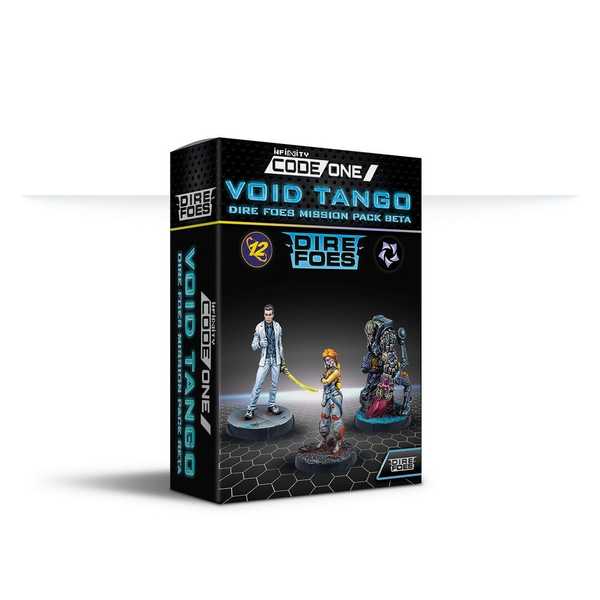
What could possibly have kept Casanova, that handsome devil, away from parties at embassies and dragged him to a dump like Hlokk Station, a mining facility in the Brisingamen Asteroid Belt? What seemed like a no-brainer mission for O-12, investigating Minescorp's dirty laundry, has turned out to be a Shasvastii covert operation. And Sargosh, the Jayth Tunnel-Crumbler, will not let Casanova thwart it, not even if some prospector gets in the way, no matter how pretty she is. Contains: 3x Dire Foes Mission Pack Beta: Void Tango Miniatures Please note: Miniatures are supplied unpainted and some assembly may be required.
£26.99 £24.30

This set includes:– 10 Attack dice, cast in yellow with darker yellow swirls and green ink– 6 Defence dice, cast in green with white flecks and yellow ink– 4 Magic dice, cast in a translucent green with yellow ink
£20.00 £18.00
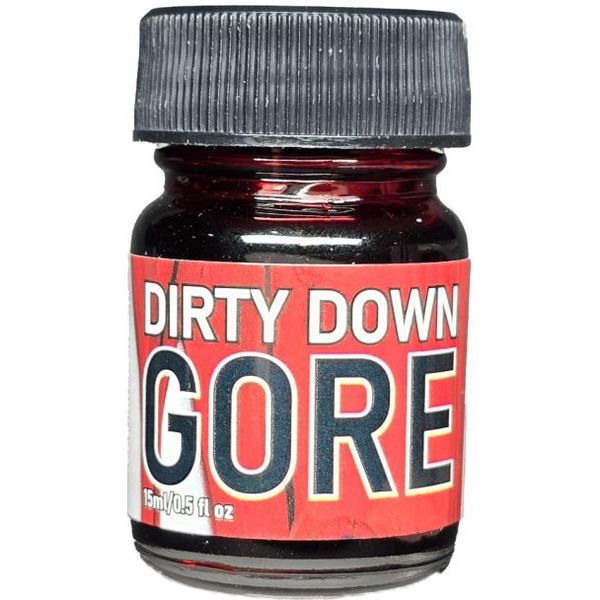
Dirty Down Gore effect creates bloody strands right out of the pot. Dip your tool then touch to a model or prop. Vary the amount of goop to create thin or thick strands for a disturbingly realistic look. Dip your tool then touch to a model or prop. Vary the amount of goop to create thin or thick strands for a disturbingly realistic look. Keep bottle sealed when not in use. Use in well-ventilated area. See Peel back label for full health and hazard information.
£13.75 £12.40
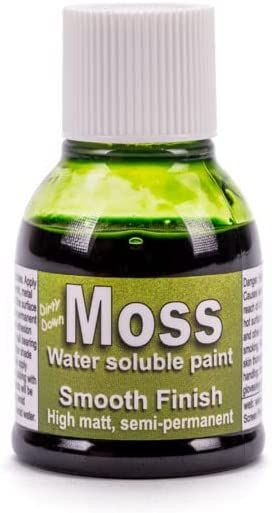
The dark coloured liquid dries to a high matt moss colour in 1 to 5 minutes depending on the temperature. Apply moss paint by brush or airbrush/sprayer. Moss effect paint looks best when applied to rough, textured surfaces. Usage Instructions: The pot and surface should be at room temperature or warmer before use. The moss colour may not appear if the pot and/or the surface are very cold. The mixture will settle on the bottom of the pot. It’s very important to thoroughly shake the pot with the ball bearings rattling before each and every use. Thoroughly stir the mixture and ensure that solids on the bottom of the pot are fully mixed into the liquid. Repeat stirring and shaking until all lumps have gone. It’s much better to shake and stir moss paint when the pot is at room temperature or warmer. If the pot is cold it may not be possible to fully mix any solids into the liquid. Use moss paint straight from the pot. Replace the lid quickly during use to prevent the liquid from evaporating or decant what you need to use for a job into a separate smaller pot/container with a lid. Do not add water into the paint pot – this may prevent the colour from forming. Ensure surfaces are clean, dry and grease free. Test the paint on hidden surfaces before use to ensure compatibility and adhesion. Only apply to non-porous surfaces such as plastic and metal. Do not apply to porous/absorbent surfaces such as bare timber or paper. Moss paint can be applied to painted surfaces, but test first. If the effect does not form, try first sealing the surface with varnish. Moss paint is water soluble and the effects of painting will be lost by washing in water or by getting wet, but there may still be staining. Do not expose moss paint to rain or splashing with water. Moss paint looks best when applied to a rough surface. To fill dents and grooves in surfaces, first cover the surface with moss paint, and then wipe the paint off the raised areas with a damp cloth (at an angle to the grooves), leaving some of the paint trapped. The wetter the cloth, the more paint removed. When fully dry, moss paint can be made more permanent by spraying with fine/mist coats of acrylic varnish/lacquer. Test varnish first because types of varnish change the colour/shade of the paint. When dry, avoid scuffing/scratching the finished paintwork. For the best results it’s best to practise different techniques listed below before final use. To darken the shade apply more coats. Allow each coat to fully dry before applying another. Any number of coats of moss paint can be applied over the top of each other. For a broken, patchy effect apply to small areas/patches at a time and allow to dry – more in some areas, less in others. The shade will vary depending on the quantity applied. A thick coat of paint will dry a darker shade, and a thin coat of paint will dry a lighter shade. Further variations in shade can be created by dabbing a damp or wet brush, cloth or tissue onto the painted surface and then leaving to dry. As the water dries, the dye in the paint separates into shades of light and dark moss. The more water used, the greater the effect. This technique can be used after the paint has dried or while it is still wet. Another option is to simply splash water onto the moss paint and leave to dry – without dabbing. For a very dark shade, decant a small amount into a separate pot and allow the paint to evaporate. The more the paint evaporates, the thicker and darker the paint gets (may not be possible to spray if too thick). Brush Application Dip the brush and immediately apply to the surface. For a patchy effect dab the paint onto a surface and keep dabbing in the same place until the paint dries. Any number of coats can be applied in this way. For a more even effect paint an even coat onto a surface. A different moss effect is obtained depending on whether a soft or stiff brush used to apply the paint. Fine Soft Brush: For very detailed work. Apply a small amount to the brush and apply directly to the surface. Larger Soft Brush: For apply larger amounts to larger areas. For a darker shade apply larger quantities and for lighter shades apply smaller quantities. Stiff Brush: Very light shades can be obtained by dabbing a very small quantity of moss paint onto a surface using a stiff brush. Allow moss paint to dry slightly on the brush for a very light effect, similar to the “dry brushing” painting technique. Always clean the brush in water straight after use. Do not let moss paint fully harden onto brush. If for any reason moss paint has dried onto a brush, soak the brush in methylated spirits to fully clean, (but check first that this will not damage the brush). Cloth/Tissue Application Pour on a cloth or tissue and dab onto a surface and keep dabbing in the same place until the paint dries. For a light shade apply a small amount at a time. For a darker shade apply a larger quantity. Spray Application Spray moss paint onto a surface straight from the pot using an air brush or pressure pot spray gun. Clean air brush immediately after use. Moss Effect is water soluble. Moss Effect can be wiped off surfaces in two ways (even when fully dry): Using a damp cotton bud. Only dampen one end of the cotton bud. Wipe moss paint with the damp end first, and then with the dry end. The wetter the cotton bud, the more moss paint is removed. Using a sheet of kitchen roll (absorbent paper towel). First apply moss paint onto the panels so that they are fully covered, and leave to dry. Flatter one end of a piece of kitchen roll, and dip this end into water. Remove most of the water from the flat end so that it’s only slight damp. This can be done by pushing the flat end against other dry pieces of kitchen roll. Gently press the damp flat end of kitchen roll against the dried moss paint, and twist the kitchen roll. Keep the kitchen roll in one place, do not wipe side to side across the surface. Some moss paint is left on the model and some removed. Some moss paint will have been wetted by the damp kitchen roll and will change shade to look darker, just like old moss. The wetter the moss paint gets, the darker the shade. Practice first to check how damp the kitchen roll should be and how much pressure to apply. Create different shades of moss using water: Apply moss paint to a surface. Apply a small amount of water to the moss paint and either allow to dry on its own, or dry by dabbing with a piece of kitchen roll or tissue. This usually causes the colours to separate and dry different shades and more patchy. Water can be applied to the surface after the moss paint has fully dried or when the moss paint is still wet.
£8.50 £7.80
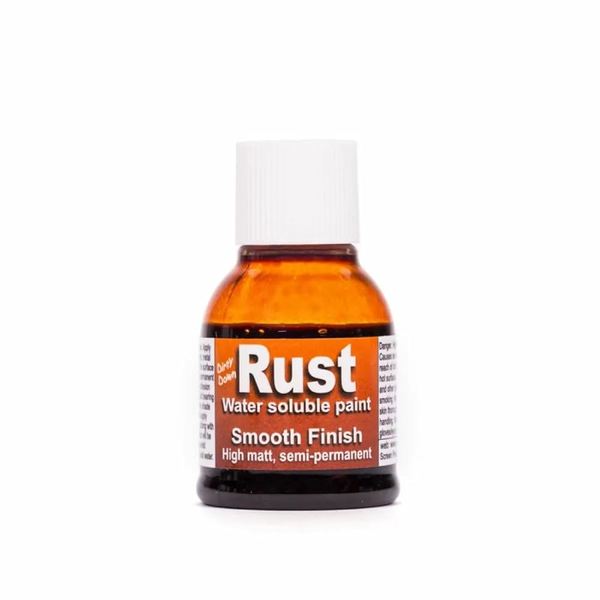
Apply rust paint by brush or airbrush/sprayer. Rust effect paint looks best when applied to rough, textured surfaces. Simulate atmospheric oxidisation of aged metals effortlessly. Water soluble to easily tone back effects for the perfect result. Usage Instructions: The pot and surface should be at room temperature or warmer before use. The rust colour may not appear if the pot and/or the surface are very cold. The mixture will settle on the bottom of the pot. It’s very important to thoroughly shake the pot with the ball bearings rattling before each and every use. Thoroughly stir the mixture and ensure that solids on the bottom of the pot are fully mixed into the liquid. Repeat stirring and shaking until all lumps have gone. It’s much better to shake and stir rust paint when the pot is at room temperature or warmer. If the pot is cold it may not be possible to fully mix any solids into the liquid. Use rust paint straight from the pot. Replace the lid quickly during use to prevent the liquid from evaporating or decant what you need to use for a job into a separate smaller pot/container with a lid. Do not add water into the paint pot – this may prevent the colour from forming. Ensure surfaces are clean, dry and grease free. Test the paint on hidden surfaces before use to ensure compatibility and adhesion. Only apply to non-porous surfaces such as plastic and metal. Do not apply to porous/absorbent surfaces such as bare timber or paper. Rust paint can be applied to painted surfaces, but test first. If the effect does not form, try first sealing the surface with varnish. Rust paint is water soluble and the effects of painting will be lost by washing in water or by getting wet, but there may still be staining. Do not expose rust paint to rain or splashing with water. Rust paint looks best when applied to a rough surface. To fill dents and grooves in surfaces, first cover the surface with rust paint, and then wipe the paint off the raised areas with a damp cloth (at an angle to the grooves), leaving some of the paint trapped. The wetter the cloth, the more paint removed. When fully dry, rust paint can be made more permanent by spraying with fine/mist coats of acrylic varnish/lacquer. Test varnish first because types of varnish change the colour/shade of the paint. When dry, avoid scuffing/scratching the finished paintwork. For the best results it’s best to practise different techniques listed below before final use. To darken the shade apply more coats. Allow each coat to fully dry before applying another. Any number of coats of rust paint can be applied over the top of each other. For a broken, patchy effect apply to small areas/patches at a time and allow to dry – more in some areas, less in others. The shade will vary depending on the quantity applied. A thick coat of paint will dry a darker shade, and a thin coat of paint will dry a lighter shade. Further variations in shade can be created by dabbing a damp or wet brush, cloth or tissue onto the painted surface and then leaving to dry. As the water dries, the dye in the paint separates into shades of light and dark rust. The more water used, the greater the effect. This technique can be used after the paint has dried or while it is still wet. Another option is to simply splash water onto the rust paint and leave to dry – without dabbing. For a very dark shade, decant a small amount into a separate pot and allow the paint to evaporate. The more the paint evaporates, the thicker and darker the paint gets (may not be possible to spray if too thick). Brush Application Dip the brush and immediately apply to the surface. For a patchy effect dab the paint onto a surface and keep dabbing in the same place until the paint dries. Any number of coats can be applied in this way. For a more even effect paint an even coat onto a surface. A different rust effect is obtained depending on whether a soft or stiff brush used to apply the paint. Fine Soft Brush: For very detailed work. Apply a small amount to the brush and apply directly to the surface. Larger Soft Brush: For apply larger amounts to larger areas. For a darker shade apply larger quantities and for lighter shades apply smaller quantities. Stiff Brush: Very light shades can be obtained by dabbing a very small quantity of rust paint onto a surface using a stiff brush. Allow rust paint to dry slightly on the brush for a very light effect, similar to the “dry brushing” painting technique. Always clean the brush in water straight after use. Do not let rust paint fully harden onto brush. If for any reason rust paint has dried onto a brush, soak the brush in methylated spirits to fully clean, (but check first that this will not damage the brush). Cloth/Tissue Application Pour on a cloth or tissue and dab onto a surface and keep dabbing in the same place until the paint dries. For a light shade apply a small amount at a time. For a darker shade apply a larger quantity. Spray Application Spray rust paint onto a surface straight from the pot using an air brush or pressure pot spray gun. Clean air brush immediately after use. Rust Effect is water soluble. Rust Effect can be wiped off surfaces in two ways (even when fully dry): Using a damp cotton bud. Only dampen one end of the cotton bud. Wipe rust paint with the damp end first, and then with the dry end. The wetter the cotton bud, the more rust paint is removed. Using a sheet of kitchen roll (absorbent paper towel). First apply rust paint onto the panels so that they are fully covered, and leave to dry. Flatter one end of a piece of kitchen roll, and dip this end into water. Remove most of the water from the flat end so that it’s only slight damp. This can be done by pushing the flat end against other dry pieces of kitchen roll. Gently press the damp flat end of kitchen roll against the dried rust paint, and twist the kitchen roll. Keep the kitchen roll in one place, do not wipe side to side across the surface. Some rust paint is left on the model and some removed. Some rust paint will have been wetted by the damp kitchen roll and will change shade to look darker, just like old rust. The wetter the rust paint gets, the darker the shade. Practice first to check how damp the kitchen roll should be and how much pressure to apply. Create different shades of rust using water: Apply rust paint to a surface. Apply a small amount of water to the rust paint and either allow to dry on its own, or dry by dabbing with a piece of kitchen roll or tissue. This usually causes the colours to separate and dry different shades and more patchy. Water can be applied to the surface after the rust paint has fully dried or when the rust paint is still wet.
£7.80
Subscribe to our emails