
Sign up for our newsletter
Subscribe to our emails
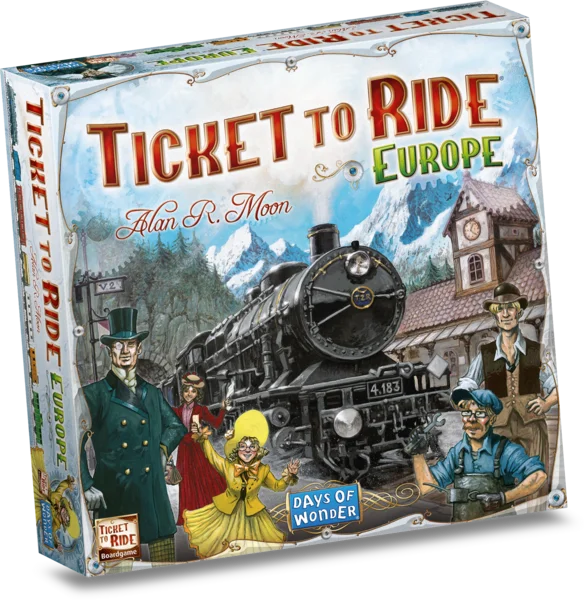
Ticket to Ride: Europe takes you on a new train adventure across Europe. From Edinburgh to Constantinople and from Lisbon to Moscow, you'll visit great cities of turn-of-the-century Europe. Like the original Ticket to Ride, the game remains elegantly simple, can be learned in 5 minutes, and appeals to both families and experienced gamers. Ticket to Ride: Europe is a complete, new game and does not require the original version.More than just a new map, Ticket to Ride: Europe features brand new gameplay elements. Tunnels may require you to pay extra cards to build on them, Ferries require locomotive cards in order to claim them, and Stations allow you to sacrifice a few points in order to use an opponent's route to connect yours. The game also includes larger format cards and Train Station game pieces.The overall goal remains the same: collect and play train cards in order to place your pieces on the board, attempting to connect cities on your ticket cards. Points are earned both from placing trains and completing tickets but uncompleted tickets lose you points. The player who has the most points at the end of the game wins.Part of the Ticket to Ride series.
£44.99 £40.50

NOTE: Chapter Two is another way of saying Second Edition. Though This Core set will be required for all future Arkham Card Game products. The world has changed. The page has turned. And now, a new chapter awaits. Introducing the newest core set for Arkham Horror: The Card Game! Serving simultaneously as both a continuation and a fresh starting point, this new core set heralds the beginning of Chapter Two for the game. Taking place several months after the city of Arkham suffered a devastating calamity, this box provides a new introductory campaign, five mechanically-new investigators, and a fresh card pool to expand your collection—or start a new one! Whether you’re an Arkham Horror veteran or a newcomer looking to get into the game, you won’t want to miss out on this new core set. This core set will replace the Revised Core Set from 2021 and become the new evergreen core experience for the game going forward. That said, all player content in this box is fully compatible with all previously-released Arkham Horror: The Card Game products—it is still the same game, after all! A new core set for Arkham Horror: The Card Game, featuring evergreen content for the foundation of any collection. Your deck is your character. Each investigator comes with a pre-built deck that represents their abilities, strengths, and weaknesses. Decks can be upgraded with experience earned in each scenario, allowing you to customize your investigator as you see fit. Uncover sinister plots and fight off horrifying monsters in scenarios inspired by the Cthulhu mythos. The narrative evolves based on your choices, successes, and failures, ensuring that each playthrough is a unique experience. This Chapter Two core set serves as a fresh starting point for newcomers and veterans alike, with new investigators and a brand-new, three-scenario introductory campaign. The Chapter Two core set is fully compatible with all previously-released Arkham Horror: The Card Game products.
£69.99 £63.00
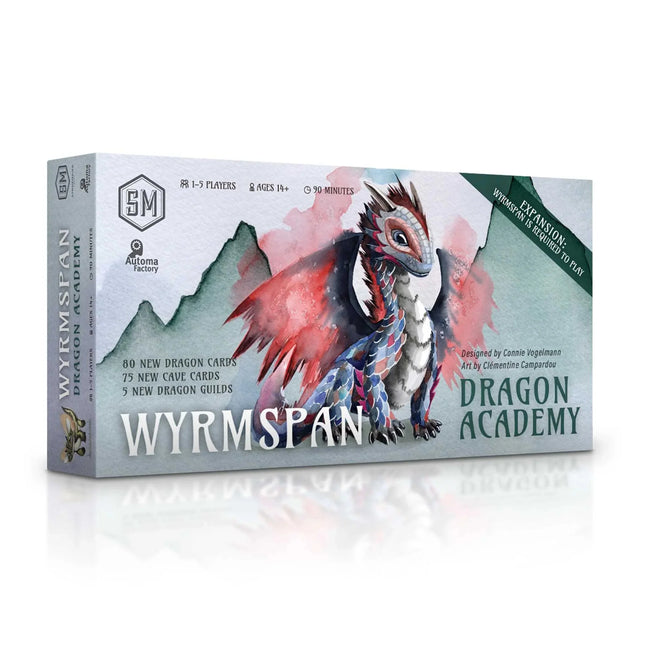
As a budding dracologist, you open an academy for fledgling dragons to achieve their full potential! The expansion to Wyrmspan adds a wide variety of new dragons and caves, objective tiles, dragon guilds, and a new round tracker that presents you with an income choice when you pass for the round. Welcome to Wyrmspan: Dragon Academy, designed by Connie Vogelmann and illustrated by Clémentine Campardou! —description from the publisher
£27.99 £24.20
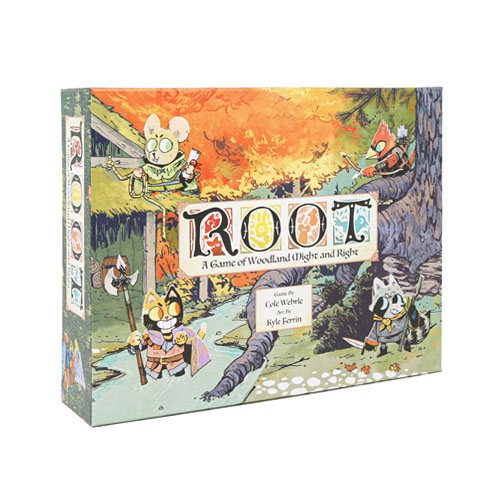
Root is a game of adventure and war in which 2 to 4 (1 to 6 with the 'Riverfolk' expansion) players battle for control of a vast wilderness.The nefarious Marquise de Cat has seized the great woodland, intent on harvesting its riches. Under her rule, the many creatures of the forest have banded together. This Alliance will seek to strengthen its resources and subvert the rule of Cats. In this effort, the Alliance may enlist the help of the wandering Vagabonds who are able to move through the more dangerous woodland paths. Though some may sympathize with the Alliance’s hopes and dreams, these wanderers are old enough to remember the great birds of prey who once controlled the woods.Meanwhile, at the edge of the region, the proud, squabbling Eyrie have found a new commander who they hope will lead their faction to resume their ancient birthright. The stage is set for a contest that will decide the fate of the great woodland. It is up to the players to decide which group will ultimately take root.Root represents the next step in our development of asymmetric design. Like Vast: The Crystal Caverns, each player in Root has unique capabilities and a different victory condition. Now, with the aid of gorgeous, multi-use cards, a truly asymmetric design has never been more accessible.The Cats play a game of engine building and logistics while attempting to police the vast wilderness. By collecting Wood they are able to produce workshops, lumber mills, and barracks. They win by building new buildings and crafts.The Eyrie musters their hawks to take back the Woods. They must capture as much territory as possible and build roosts before they collapse back into squabbling.The Alliance hides in the shadows, recruiting forces and hatching conspiracies. They begin slowly and build towards a dramatic late-game presence--but only if they can manage to keep the other players in check.Meanwhile, the Vagabond plays all sides of the conflict for their own gain, while hiding a mysterious quest. Explore the board, fight other factions, and work towards achieving your hidden goal.In Root, players drive the narrative, and the differences between each role create an unparalleled level of interaction and replayability. Leder Games invites you and your family to explore the fantastic world of Root!—description from the publisher
£59.99 £54.00
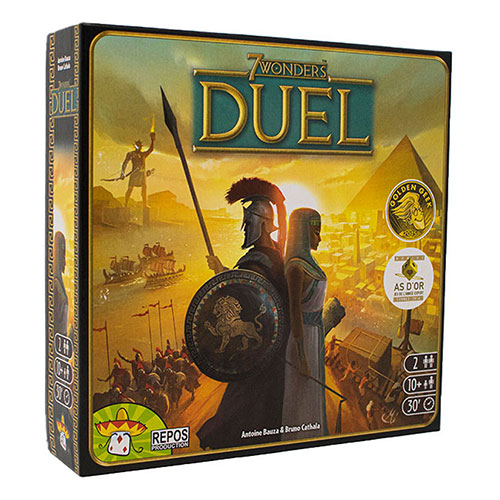
In many ways 7 Wonders Duel resembles its parent game 7 Wonders as over three ages players acquire cards that provide resources or advance their military or scientific development in order to develop a civilization and complete wonders.What's different about 7 Wonders Duel is that, as the title suggests, the game is solely for two players, with the players not drafting cards simultaneously from hands of cards, but from a display of face-down and face-up cards arranged at the start of a round. A player can take a card only if it's not covered by any others, so timing comes into play as well as bonus moves that allow you to take a second card immediately. As in the original game, each card that you acquire can be built, discarded for coins, or used to construct a wonder.Each player starts with four wonder cards, and the construction of a wonder provides its owner with a special ability. Only seven wonders can be built, though, so one player will end up short.Players can purchase resources at any time from the bank, or they can gain cards during the game that provide them with resources for future building; as you acquire resources, the cost for those particular resources increases for your opponent, representing your dominance in this area.A player can win 7 Wonders Duel in one of three ways: each time you acquire a military card, you advance the military marker toward your opponent's capital, giving you a bonus at certain positions; if you reach the opponent's capital, you win the game immediately; similarly, if you acquire any six of seven different scientific symbols, you achieve scientific dominance and win immediately; if none of these situations occurs, then the player with the most points at the end of the game wins.
£24.99 £22.50
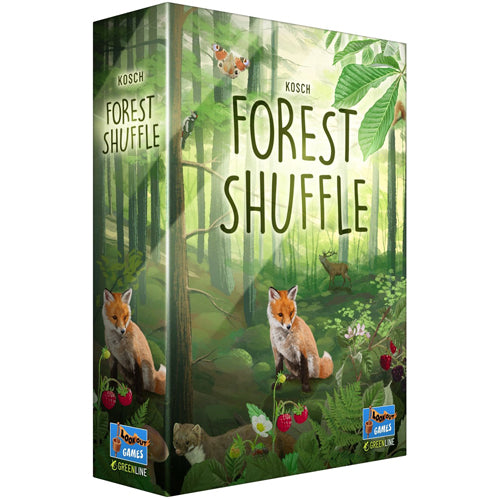
In Forest Shuffle, players compete to gather the most valuable trees, then attract species to these trees, thus creating an ecologically balanced habitat for flora and fauna.To start, each player has six cards in hand, with cards depicting either a particular type of tree or two forest dwellers (animal, plant, mushroom, etc.), with these latter cards being divided in half, whether vertically or horizontally, with one dweller in each card half.On a turn, either draw two cards — whether face down from the deck or face up from the clearing — and add them to your hand, or play a card from your hand by paying the cost, then putting it into play.Each tree and dweller shows a cost, and to pay this cost, you must discard cards from your hand into the clearing face up. If you play a tree, flip the top card of the deck into the clearing, then place the tree in front of you. If you play a dweller, pay only the cost on the dweller you choose, then slide this card under a tree that has an empty side that matches the dweller you want to play. (A tree can have cards played on all four sides of it: top, bottom, left, and right.)Alternatively, you can play a card face down as a tree sapling. This card costs nothing and can have dwellers played on it, but it has no species, whereas each tree is one of eight species.After you play a card, you can use the effect on this card (drawing cards, placing additional cards, taking another turn, etc.) or gain the bonus you gained if you paid for this card with cards of the same color — or both, if applicable, with the effect taking place before the bonus.If at the end of your turn the clearing contains more than nine cards, place all of these cards in the box out of play.During set-up, three winter cards were placed into the bottom third of the deck. When the third winter card is drawn, the game ends immediately, then players tally their points based on the trees and dwellers in their forest. Whoever scores the most points wins.Forest Shuffle is the first in a line of Lookout games sporting the Lookout Greenline label, produced on FSC certified paper and avoiding plastic completely.
£26.99 £24.30
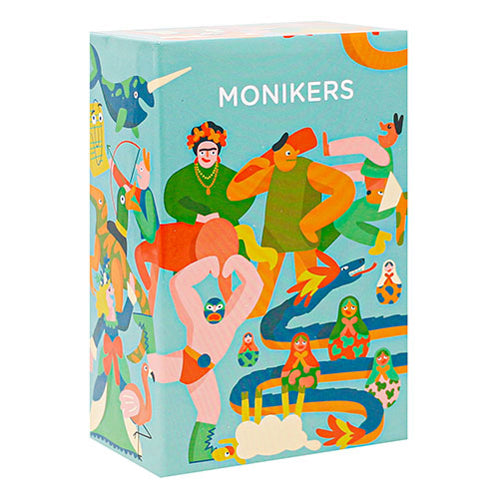
Monikers is a party game based on the public domain game Celebrity, where players take turns attempting to get their teammates to guess names by describing or imitating well-known people.In the first round, clue givers can say anything they want, except for the name itself. For the second round, clue givers can only say one word. And in the final round, clue givers can’t say anything at all: they can only use gestures and charades.
£30.00 £27.00
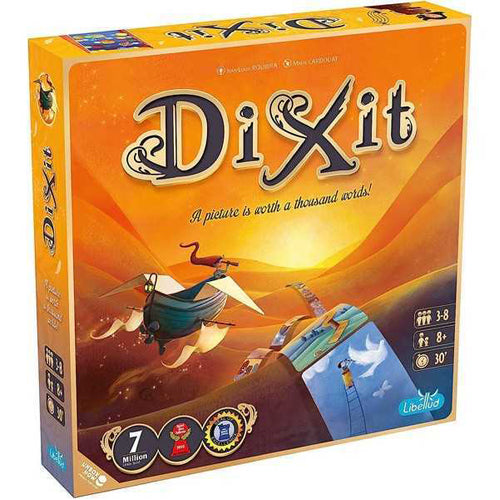
2010 Spiel des Jahres WinnerOne player is the storyteller for the turn and looks at the images on the 6 cards in her hand. From one of these, she makes up a sentence and says it out loud (without showing the card to the other players).Each other player selects the card in their hands which best matches the sentence and gives the selected card to the storyteller, without showing it to the others.The storyteller shuffles her card with all the received cards. All pictures are shown face up and every player has to bet upon which picture was the storyteller's.If nobody or everybody finds the correct card, the storyteller scores 0, and each of the other players scores 2. Otherwise the storyteller and whoever found the correct answer score 3. Players score 1 point for every vote for their own card.The game ends when the deck is empty or if a player scores 30 points. In either case, the player with the most points wins the game.The base game and all expansions have 84 cards each.
£29.99 £27.00
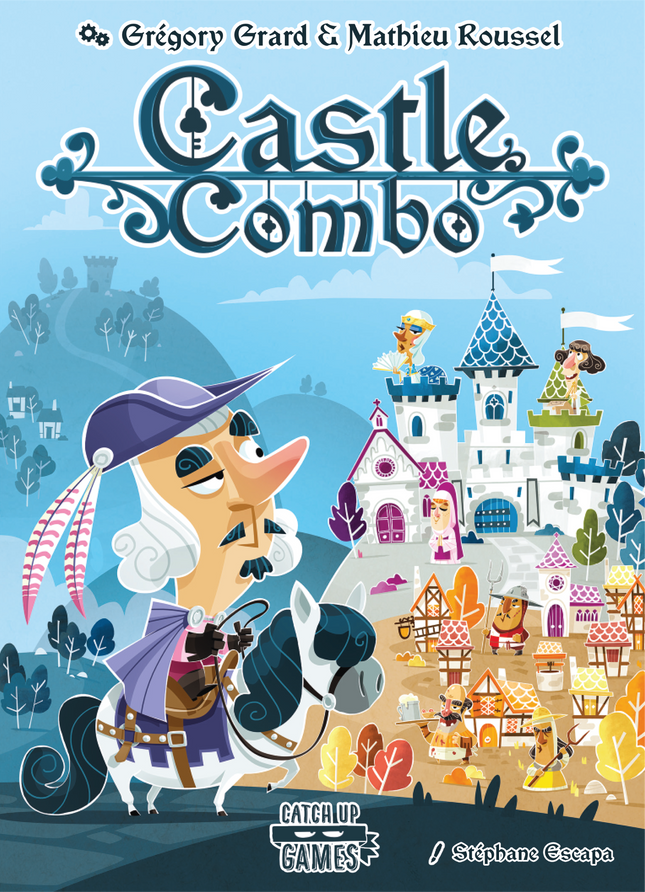
Castle Combo is a tableau-building game that combines simplicity with deep, engaging gameplay, offering highly satisfying experiences.Each player will spend coins to draft 9 cards from 2 open markets on the table (the lower and upper city), creating along the game a 3x3 square of people interacting with each other to trigger instant effects and end-of-game bonuses.Each turn, you add a character to your tableau — a seemingly straightforward action that packs a punch regarding strategic decisions. You'll need to carefully manage your Keys to influence the Messenger pawn at critical moments, as it controls which characters are available for recruitment from two different areas – peasants and nobles.Balancing your Gold reserves is equally important, ensuring you can afford the characters that best suit your strategy throughout the game. Selecting the right characters is crucial to maximising their immediate effects and the points they will contribute at the game's end. Finally, carefully arranging these characters on your 3x3 board is key to unlocking their full potential.After everyone has played 9 turns (i.e., everyone has 9 characters in front of them), the player with the most points in their tableau wins the game.
£20.00 £18.00
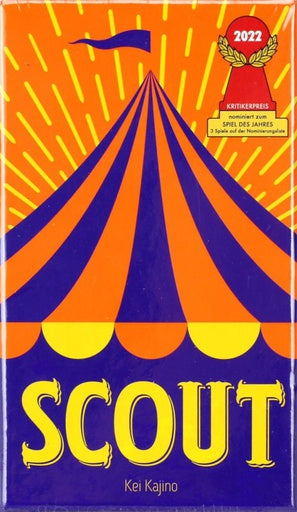
SCOUT is a ladder-climbing game in which cards have two potential values, players may not rearrange their hand of cards, and players may pass their turn to take a card from the current high set of cards into their hand. More specifically, cards are dual-indexed, with different values on each half of the card, with the 45 cards having all possible combinations of the numbers 1-10. During set-up, whoever is shuffling the cards should randomize both the order of the cards in the deck and their orientation. Once each player has been dealt their entire hand of cards, they pick up that hand without rearranging any of the cards; if they wish, they can rotate their entire hand of cards in order to use the values on the other end of each card, but again they cannot rearrange the order of cards in their hand. On a turn, a player takes one of two actions: • Play: A player chooses one or more adjacent cards in their hand that have all the same value or that have values in consecutive order (whether ascending or descending), then they play this set of cards to the table. They can do this only if the table is empty (as on the first turn) or the set they're playing is ranked higher than the set currently on the table; a set is higher if it has more cards or has cards of the same value instead of consecutive cards or has a set of the same quantity and type but with higher values. In this latter case when a player overplays another set, the player captures the cards in this previous set and places them face down in front of themselves. • Scout: A player takes a card from either end of the set currently on the table and places it anywhere they wish in their hand in either orientation. Whoever played this previous set receives a 1 VP token as a reward for playing a set that wasn't beaten. Once per round, a player can scout, then immediately play. When a player has emptied their hand of cards or all but one player have scouted instead of playing, the round ends. Players receive 1 VP for each face-down card, then subtract one point for each card in their hand (except if they were the player scouted repeatedly to end the game). Play as many rounds as the number of players, then whoever has the most points wins.
£20.00 £18.00
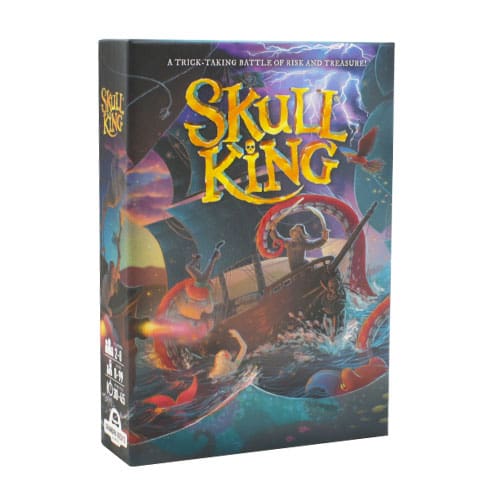
Skull King is a trick-taking game similar to Oh Hell!, Wizard, Euchre and Spades, with players needing to state how many tricks they think they'll win each round. A unique element of this game is that bidding takes place simultaneously, leading to rounds that are sometimes over, or under-bid. As players must win the exact number of tricks that they bid to earn points, winning too many tricks is just as bad as winning too few and this leads to intense competition where losing a trick can be as exciting as winning one.Skull King uses a 66-card deck that consists of five Escape cards, four suits numbered 1-13, five Pirate cards, 1 Tigress card, and 1 Skull King card. The game lasts ten rounds, and in each round, each player is dealt as many cards as the number of the round. All players simultaneously bid on the number of tricks they think they'll take by holding out a fist and on the count of three revealing a certain number of fingers (or possibly a closed fist for a bid of zero tricks).Standard rules apply for the playing of cards, with one player leading off a card and other players following suit, if possible, and playing something else if not; however, a player may always choose to play one of the special, unnumbered cards — and the power of those cards might let you win a trick that otherwise would have gotten away. In more detail, the black Jolly Roger suit trumps the other three suits, a Mermaid trumps all numbered cards, a Pirate trumps the Mermaid, and the Skull King trumps everything — except if he appears in the same trick with a Mermaid, in which case she captures him and wins instead. An Escape card loses to any other card, and the Tigress card serves as either a pirate or escape card as desired by the player. Whoever wins a trick leads in the next trick.If a player makes their bid exactly, they score 20 points per trick; if they collect more or fewer tricks, they lose 10 points per trick they are off. If a player makes a bid of zero tricks, they win points equal to ten times the current round number — but if they take even a single trick, they lose this many points instead. If a player catches pirates with the Skull King, or the King with a mermaid, they score bonus points. Whoever has the most points after ten rounds wins.
£17.00 £15.30
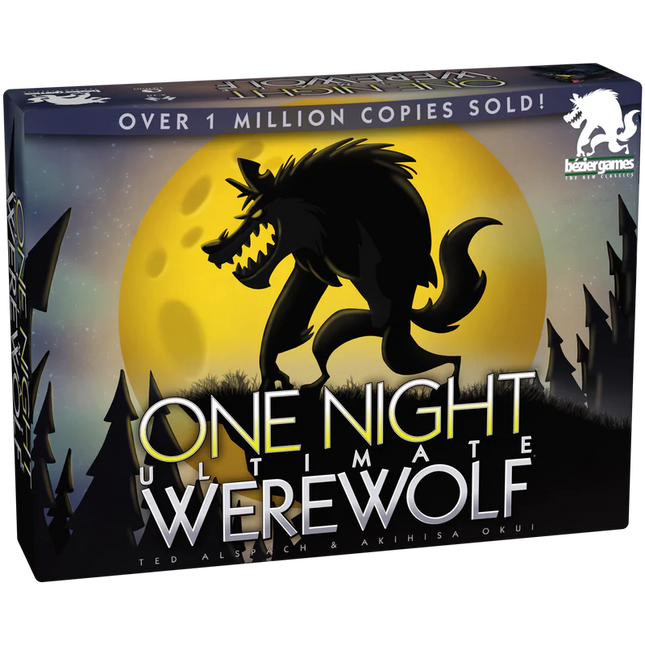
No moderator, no elimination, ten-minute games.One Night Ultimate Werewolf is a fast game for 3-10 players in which everyone gets a role: One of the dastardly Werewolves, the tricky Troublemaker, the helpful Seer, or one of a dozen different characters, each with a special ability. In the course of a single morning, your village will decide who is a werewolf...because all it takes is lynching one werewolf to win!Because One Night Ultimate Werewolf is so fast, fun, and engaging, you'll want to play it again and again, and no two games are ever the same.This game can be combined with One Night Ultimate Werewolf Daybreak.
£24.99 £22.50
Subscribe to our emails