
Sign up for our newsletter
Subscribe to our emails

The most produced Cruiser tank of the European theatre! Armed with a potent 75mm gun and with good cross country performance this vehicle was more than a match for the venerable Panzer IV! Though sadly it was still outclassed by the German "Big Cats" Cromwells were used in the 7th armoured division and in the armoured recce regts of the Guards and 11th Armoured Divisions. Even the 6th Airborne armoured recce regt acquired about 8 Cromwells in Normandy and kept hold of them during the Winter fighting in "The Bulge". Normally a troop would comprise 3 Cromwells and a Firefly. The new kit includes an optional Culin Prong hedgerow cutter for those of you wanting to burst through the Normandy bocage! It also comes with a full-colour waterslide decal sheet with many options in terms of the formation you can build - British, Canadian and Polish units are included.
£25.00 £22.50

The Sherman Tank was the main stay of the American army. The Break out from the Normandy beaches and the bocage could never been achieved without the armoured support. Although they had their weaknesses their impressive adaptability, firepower and large production numbers enabled the Allies to over power the Germans.
£25.00 £22.50

The Churchill, undoubtedly one of the most successful and famous British tanks of the Second World War. The British Army adopted a doctrine centered around the use of light, fast ‘Cruiser Tanks’ coupled with slow, better armed and armoured ‘Infantry Tanks’, that would be used to smash the enemy defences with infantry support… and the Churchill was a prime example of the latter – one of the heaviest Allied tanks of the war, it featured thicker frontal armour than that even of the Tiger! Although it suffered from being under-armed, a defect common to most British armoured vehicles of the period, it was nevertheless loved by its crews: its cross-country ability was unrivalled and it was less inclined to ‘brew-up’ from a direct hit than the Sherman. In this plastic kit from Warlord and Italari you’ll get 7 turret variations (yes – we said SEVEN!) allowing you to build the following marks: MkIII – with 6pdr gun MkIV – Cast turret with 6 pdr gun MkV – Cast turret with 95m Howitzer MkVI – Cast turret and Welded turret with 75mm gun NA 75 AVRE (Armoured Vehicle Royal Engineers) with 290mm Petard Mortar (aka the flying dustbin!) This vehicle can also be used in games of Achtung Panzer!, the game of close-quarters tank-on-tank combat, its rules can be found in the Achtung Panzer! rulebook.
£25.00 £22.50

As American tank designers began to recognise the outdated and obsolete nature of the M2 light tank, they realised they needed to create something new. The M3 Stuart was a direct upgrade from its predecessor, the M2 light tank, with thicker armour, modified suspension and new recoil system. The M3 Stuart used the 37mm M5 gun (later to be replaced by the new, slightly longer M6 gun) as well as five mounted Browning machine guns. This was the first U.S. tank to partake in tank-versus-tank combat in World War 2, where a platoon of five Stuarts engaged the Imperial Japanese Army (IJA) 4th Tank Regiment's Type 95 Ha-Go light tanks. The Stuart stands tall, and was favoured by many crews due to its fairly high speed. It was mechanically reliable and obtained the nickname "Honey" due to its smooth ride. During 1942, the British Army decided to keep their Stuarts away from tank-versus-tank combat and instead use them for reconnaissance. A number of Stuart variations arose, including the Stuart Recce, the Stuart Kangaroo and the Stuart Command. Making a conversion of these is easy with the new plastic Stuart. The Recce had the turret removed in order to achieve an improved speed and range, while the Kangaroo had been converted into an armoured personnel carrier. The M3 proved itself as an effective armoured vehicle in jungle environments, where the Japanese infantrymen found themselves under-equipped and lacking anti-tank weaponry. This left them with only one option, which was to rely on close assault tactics. The Stuart was an impressive counter to this, and in this setting was barely any more vulnerable than a medium tank. Principal service: 1940–43. Numbers manufactured: 5,811. Principle combatants: British American Soviet Chinese Captured and used by: German Japanese This box contains 1 x plastic M3 Light tank with options to use: 5 MMG Flamethrower External Fuel tanks Sand guards Rounded or plate turret variants Models supplied unassembled and unpainted
£22.00 £19.80

Amongst the most feared tanks in the Second World War, the mere mention of the name ‘Tiger’ was enough to cause panic amongst Allied armoured formations. The Tiger was hurried into action on the Russian front as a response to the heavier Soviet tanks that had caught the Wehrmacht unawares. Its massive square body and rounded turret was an intimidating sight to enemy tankers. The armour was tremendously thick and made of quality steel, making it largely invulnerable, at least frontally, to anti-tank fire. Its potent 88mm gun was a deadly weapon, effective against enemy tanks up to three kilometres and also firing a lethal high explosive shell. This vehicle can also be used in games of Achtung Panzer!, the game of close-quarters tank-on-tank combat. Its rules can be found in the Achtung Panzer! rulebook.
£25.00 £22.50

The German soldier was a formidable opponent in World War II. Tough, well-trained and politically indoctrinated they fought on all fronts achieving great feats of arms that only the best trained and motivated troops can accomplish. Daring in attack and stubborn in defence the average German Landser was a dangerous foe for the Allied armies to face.Well led from the highest command right through to the infantry squad, the German soldier fought on against overwhelming odds right to the last days of the war, delivering punishing counterattacks when least expected.These superbly sculpted plastic miniatures allow you to field squads of German landsers dressed in late war M44 tunics, camouflage zeltbahn poncho, etc. They can be equipped with a wide variety of some of the best weaponry available to any army of the war - from the deadly STG44 assault rifle to the tankbusting panzerfaust!German Grenadiers contains:Enough plastic components to make 30 late war German Army miniatures. Includes a host of options to allow for different weapon configurations and command models. Equipment included: STG44 assault rifle, PPSh SMG, Kar 98K rifle, MG42 light machine gun, rifle grenade attachment, MP40 sub-machine gun,Kar 98K rifle, Gewehr 43 rifle, stick grenades, Panzerfaust, field glasses and even an Iron Cross medal! Round plastic bases (25mm diameter). Construction leaflet. Full-colour waterslide decals.
£37.00 £33.30

This awesome plastic US Airborne Late WWII Paratroopers platoon contains enough plastic components to make 30 US Airborne miniatures in M-1943 uniforms, plus a host of options to allow for different weapon configurations and command models. Having blooded themselves during the fighting in Sicily in 1943 and then fought in arguably their most famous operations during the D-Day landings in June 1944, the US Airborne divisions were withdrawn from the front lines to rest and refit. Re-equipped with the new green M-1943 uniform which was being used across the US military to standardise supply, the divisions which included the 101st ‘Screaming Eagles’ and the 82nd ‘All American’ would be used by Allied High command during Operation Market Garden - an ambitious plan to open a corridor through Holland by parachuting in several US, British and Polish airborne divisions to take key bridges. Following the ill-fated Market Garden, US paratroopers would drop into Germany in 1945 as part of Operations Varsity and Plunder - the crossing of the mighty River Rhine itself. These battle-hardened fighting men have been immortalised in film and television - A Bridge Too Far and Band of Brothers are both great sources of inspiration for these troops and the actions they fought in so heroically. Contains a 30-man plastic US Airborne Platoon: x5 each of 15 different heads x5 LMG with bi pod x5 bodies kneeling x5 bodies prone x20 bodies running/standing x5 LMG with bi pod x5 BAR Arms with Rifles, Carbines, SMGs, pistols, binoculars, machete. Pouches, Pigeon, ammo, holsters, knives, backpacks and other gear. Construction leaflet including new Bolt Action rules entry. Full colour waterslide decal sheet. Weapons included: M1 Garand rifle, Thompson submachine gun, Browning pistol, Browning Automatic Rifle (BAR), M1 Carbine, hand grenades, machete, and .30 Cal medium machine gun. Note: Models supplied unassembled and unpainted
£37.00 £33.30

Defend the Motherland and take the war to the Axis with the Soviet Army Infantry Platoon! The backbone of the Soviet Union’s military might was its vast abundance of manpower, enabling the desperate defences and grand offensives that raged across the Eastern Front, and Bolt Action tables. This box contains 30 infantry models in ‘summer’ uniforms, allowing you to build a huge variety of Soviet units. On each sprue, you’ll find a wide range of weaponry, including Mosin-Nagant rifles and carbines, DPM light machine guns, a PRTD anti-tank rifle, and of course lots of submachine guns, just to name a few. There’s also a captured German Panzerfaust, a scoped sniper’s rifle, and plenty of extra pieces such as megaphones, camouflage capes, and even a ‘liberated’ chicken to allow you to build even more units from this kit, and add character to your force. Even a dog is included, for all of your canine needs! A full set of heads in helmets and another in NKVD caps gives you yet more options – this kit really can do it all!
£37.00 £33.30

Few divisions in the British Army have earned such a valorous reputation so quickly as the Parachute Division. Known as the Red Devils by the Germans for their trademark maroon beret and dogged fighting ability, the British airborne grew into a force to be reckoned with, whether delivered by Dakota aircraft, Horsa glider or as front line shock troops. This box set contains: Enough plastic components to make 30 British or Polish Airborne miniatures. Includes a host of options to allow for different weapon configurations and command models. Plenty of equipment including: Lee Enfield rifle, Mk V Sten Gun, Bren gun LMG, scoped Lee Enfield rifle, PIAT, Webley pistol, Mills Bomb hand grenades. Round plastic bases (25mm diameter). Full-colour waterslide decal sheet Construction leaflet. This set also allows for Polish airborne troops to be built – their larger grey berets being a distinctive difference to their British counterparts. Although comparatively lightly-armed, British Paras could dish it out and would not hesitate to close to hand-to-hand fighting if needs be. Warlord Games’ British Airborne are ideal for fighting in North West Europe where they could be used to re-fight actions such as the assault on the Merville battery, the coup de main attack on Pegasus Bridge, the heroic battles of Operation Market garden or onward to the crossing of the Rhine and Operation Varsity. Please note: Miniatures are supplied unpainted and some assembly will be required.
£37.00 £33.30

This fantastic dice bag, proudly bearing the Union Flag, is ideal for drawing your Order Dice from during a game of Bolt Action, and between games makes for an ideal place to store all your dice. Please Note: One Bolt Action: British Dice Bag is supplied.
£20.00 £18.00
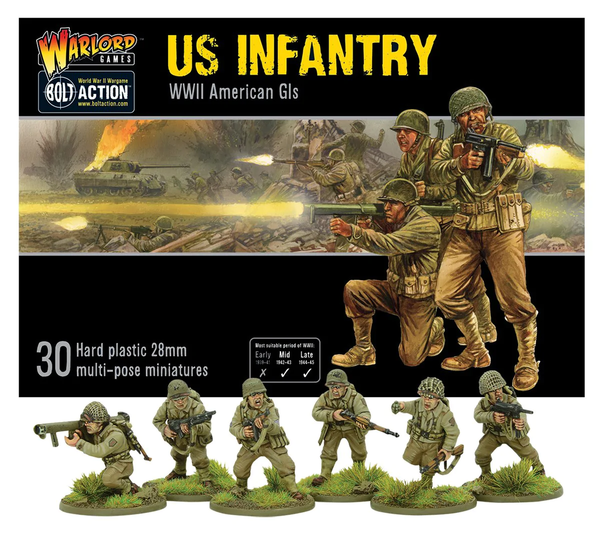
Backed by America's industrial might, the US infantryman was a formidable opponent. Learning well from early reverses, the US Army quickly became an almost unstoppable fighting machine, of which the backbone was the humble foot soldier, or G.I. Taking the flight to the Germans, Italians and Japanese in all theatres of the war, the American GI helped turn the tide against the aggression of Nazi Germany and her allies. This box gives you a platoon of tough, well-trained troops with enough firepower to successfully perform almost any task given to them. American troops were aggressive, resourceful and supremely well-equipped. These miniatures are usable as almost all types of regular American line troops - from the US entry into WWII in the Mediterranean through to the war's end in Europe. They can, of course, be fielded as other nations - Uncle Sa, outfitted all manner of troops from his stores. These G.I.s could be painted as late war French (post D-Day) or even Brazilians fighting in Italy! Contains: Plastic components to make 30 US Army infantrymen. Includes optional weapon configurations, command models as well as early and late version backpacks. Weapons Included: M1 Garand Rifle Browning Automatic Rifle Thompson and Grease Gun Sub-machine Guns M1 Carbine Bazooka Colt .45 Pistol Fragmentation Grenades Bandoliers Combat Shotgun Round Plastic Bases (25mm Diameter) Construction Leaflet Full-colour Waterslide Decals Please note: Miniatures are supplied unpainted and some assembly may be required.
£33.30
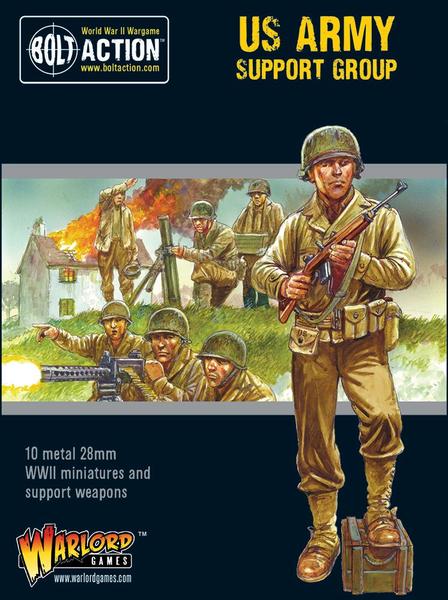
This set contains: 1 x US Army HQ 1 x US Army Medium Machine Gun Team 1 x US Army Medium Mortar Team HQ American forces started the war with no experience of combat and often with minimal training. Once exposed to the realities of warfare both officers and men learned quickly. However, the constant demand for troops meant that relatively Inexperienced offers could still find themselves leading men into action even at the end of the war. Both experience and promotion often came very quickly whether in Europe or the Pacific.Medic The field medic presents the wounded soldier with his best chance of surviving serious injury and can ensure those lightly wounded soldiers are returned to fighting fitness as rapidly as possible. Junior medical staff, such as stretcher-bearers, can accompany medics in the field. Medical officers were not always armed but in practice, a pistol was often carried for self-defence.Medium Machine Gun The Americans were equipped with an excellent medium machine gun: the Browning M1919A4 .30-cal. Because of its weight (31lbs), it was always used with a tripod. It had a rate of fire of 500 rounds per minute and an effective range of over 1,000 metres.Medium Mortar In the American army, the role of medium mortar was fulfilled by the 81mm calibre M1 mortar. The mortar was the biggest killer of infantrymen throughout the war. An average crew could fire a dozen bombs in a minute. Compared with artillery shells that had a tendency to get ‘buried’ on landing, directing a good portion of the explosion into solid ground, mortar bombs fell almost on their nose and released destructive power all around.Models supplied unassembled and unpainted
£26.60
Subscribe to our emails