
Sign up for our newsletter
Subscribe to our emails
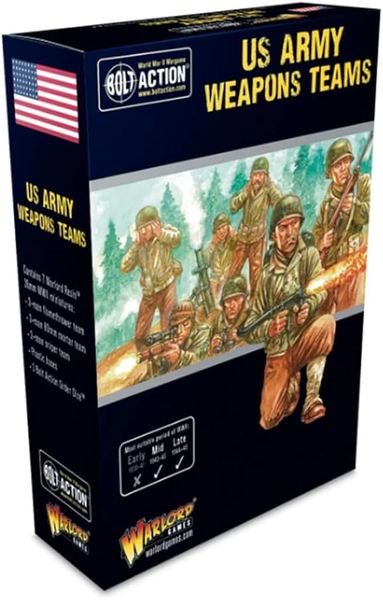
Infantry weapons teams are a key component of any Bolt Action army, providing as they do great tactical flexibility for your force. Anti-tank teams and flamethrower teams are among the most prevalent, presenting your opponent with multiple challenges to overcome. The tasks of scouting and sniping were similar in American doctrines. In the US manual it was clearly stated that the duty of a sniper was to kill enemy officers in order to damage the morale of enemy troops. They were equipped with a telescopic sight on a M1903 bolt-action Springfield rifle, and also had close-combat weapons such as pistols and shotguns with which to defend themselves if discovered. Both members of the team had sniper training so the role of spotter was interchangeable. Mortars were the most commonly available type of support weapon. Paratroopers and Rangers had one mortar per platoon, in addition to those that may have been assigned at company level. Normally they were deployed in a suitable rear position, no further than 100 yards from the observer in order to ‘cover the most dangerous approaches to the platoon area’. The standard light mortar was of relatively large calibre at 60mm. It fired a correspondingly larger and more effective shell over a greater range than the smaller mortars used by the Germans and the British. The only problem was the weight (19kg) that meant a larger team was needed to move it. Flamethrowers were used throughout the war, especially in the Pacific, to clear out tunnels and bunkers. During the Normandy landings, the number of flamethrowers was increased to allow the men to open a gap in the fortified lines. Contains: 7x Figures 3x Order Dice Please Note: Miniatures are supplied unpainted and unassembled.
£14.40
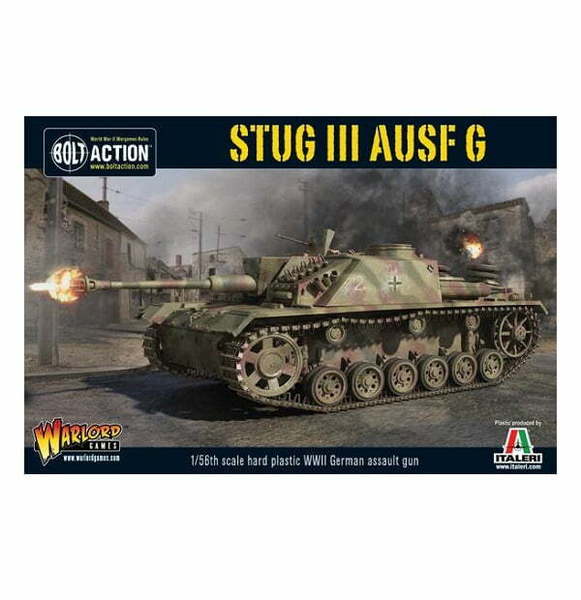
The Sturmgeschütz (StuG) III was a well-armed and armoured vehicle based on the tried and tested Pz.Kpfw III chassis. Manned by the artillery originally, as it was considered a mobile howitzer, it went through many variants during WWII, and indeed was one of the few German AFVs to serve throughout the war on all fronts. The StuG III had good frontal armour, its low profile making it ideal for performing ambushes, presenting a poor target for return fire. It is armed with an efficient and powerful 75mm gun and carries an MG42 for close defence. The StuGs were welcomed by their infantry comrades, supporting their attacks with HE shells or knocking out enemy tanks to the extent that by the end of hostilities, they had amassed more kills than any other German vehicle. This highly detailed plastic kit can be built as either the StuG III Ausf G assault gun or as the 10.5cm Sturmhaubitze infantry support gun. Contents: 1 plastic Stug - either 1 x Stug III ausf G or 1 x StuH-42 1 decal sheet This vehicle can also be used in games of Achtung Panzer!, the game of close-quarters tank-on-tank combat, its rules can be found in the Achtung Panzer! rulebook.Note: Models supplied unassembled and unpainted
£22.50
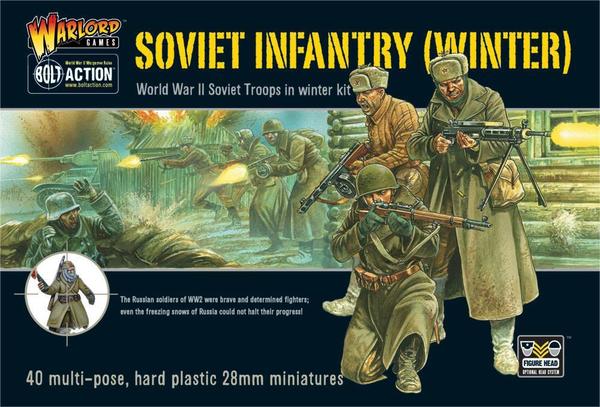
When the German army crashed in to Russia in 1941, Hitler was confident of a short and sharp campaign, which he nearly received. However, the heroic defence by the massive soviet armies slowed the Nazi advance. This was done by several brave and loyal soldiers, even though their equipmet was unsophisticated, it was functional, much like the troops themselves and they last a long time againts the Germans. The Red Army had learnt some hard lessons during the bitter fighting in Finals where thousands of men fell victim to frostbite. The cold weather kit later issued was much warmer and comfortable than before. These tough men may have had to lie for hours in the snow before making the attacks. Please Note: Models are supplied unpainted and some assembly may be required.
£38.30
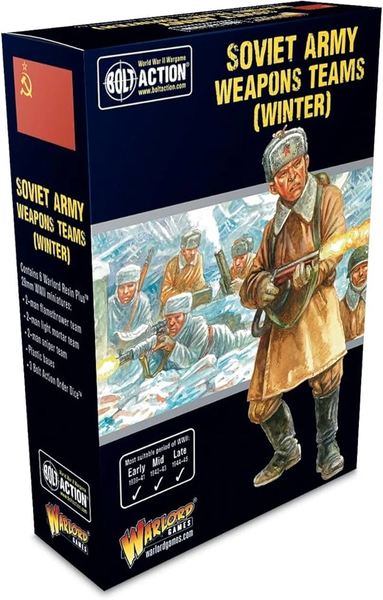
Infantry weapons teams are a key component of any Bolt Action army, providing as they do great tactical flexibility for your force. Sniper teams, flamethrower teams and light mortar teams are among the most prevalent, presenting your opponent with multiple challenges to overcome. The sniper became synonymous with the Red Army, particularly during the grim sieges of Stalingrad and Leningrad. ‘Sniper schools’ were established in bombed-out buildings and cellars, where successful snipers passed down their skills to ever-growing numbers of students – many of them women. Soviet propaganda lavished attention on successful snipers and encouraged a doctrine of ‘sniperism’ among the troops. Snipers used telescopic sights on either a bolt action Moisin-Nagant 1891/30, or, more rarely, a Tokarev SVT-40 smi-automatic rifle. A variety of ammunition was used, including tracer and armour-piercing rounds. Soviet snipers were available at company level working as teams or sometimes on their own. Individual Red Army squads would often have a designated marksman with a scoped rifle to help compensate for the lack of long-range firepower due to the large numbers of submachine guns in use. Soviet snipers became renowned for their fieldcraft, stealth and patience. The most successful snipers each accounted for hundreds of the enemy – around 500 being the greatest tally recorded by a single sniper. The standard light mortar used by Russian infantry during World War II was the 50mm Infantry Mortar Model 1940 (50-PM 40), a cheaper version of the earlier model 1938, In addition, the Soviet army received considerable numbers of 2-inch mortars from Britain via Lend-Lease. The 50mm was deemed a ‘company’ mortar as opposed to the heavier 82mm battalion and 120mm regimental mortars. The allocation of 50mm mortars was initially to individual teams at platoon level, but later they were more often concentrated together at company level for use en masse. The weapon was easily man-portable and could lay down a high explosive or smoke bombs at a range of over 800 yards. The Soviets made great use of flamethrowers including FOG-1 static types dug in to cover bunkers and trenches. Due to shortcomings in developing other credible anti-tank weapons, Red Army doctrine placed strong emphasis on using flamethrowers as anti-tank as well as anti-infantry weapons. They even formed separate motorised anti-tank flamethrower battalions in 1943. By far the most common Russian flamethrowers were the man-packed ROKS types. The ROKS-2 was designed with a fuel tank that looked like an ordinary backpack and a nozzle resembling a rifle, so as not to attract unwelcome attention on the battlefield. Box contains: Six Warlord Resin™ Figures Plastic Bases Three Order Dice These figures are cast in our new and improved Warlord Resin Plus™. For more information on this material click here Models supplied unassembled and unpainted
£14.40
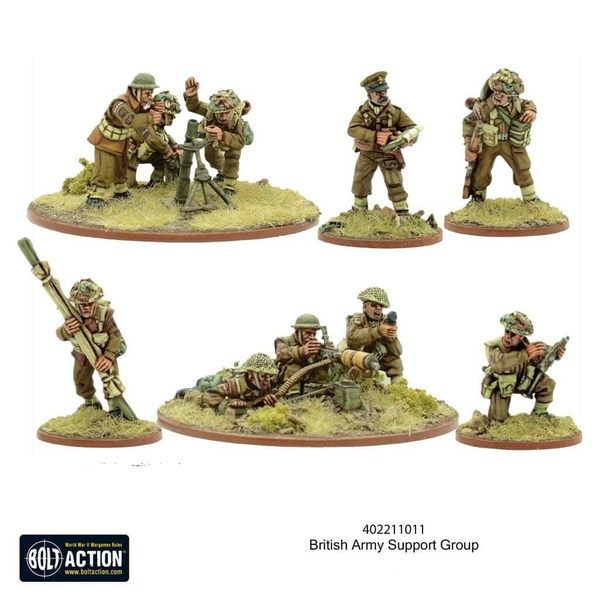
The British Tommy faced his Axis adversaries throughout the war with tenacity, bravery and his legendary love of a 'brew'. After years of fighting in North Africa and the Far East the British Army set foot back in Europe with the invasion of Sicily and Italy. In 1944 they spearheaded the D-Day landings in Normandy before pushing on into the German homeland and ultimate victory. British soldiers made good use of the water-cooled Vickers machine gun - the same weapon their fathers use in the Great War - and the 3" mortar.Contains: 2 officers 1 Medic 1 Forward Observer 1 medium mortar team 1 Vickers MMG team Bases Models supplied unassembled and unpainted
£26.60
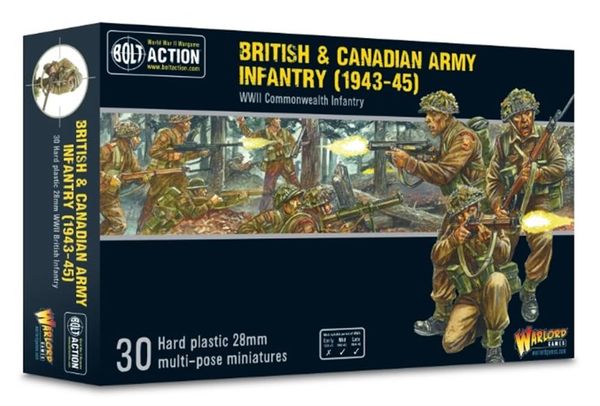
The new plastic kit for the British and Canadians is fantastically detailed and allows for myriad customization options. Our customer service boffins worked out that there are a possible 396 variations that can be made BEFORE the consideration of optional heads and additional accessories such as maps, waving arms and binoculars. The new kit is packed with optional extras, with head options for steel helmets, assault helmets and Tam o’shanter caps (for Scottish or Canadian troops), as well as weapons including Lee Enfield No 4 rifle, Bren light machine gun, Sten sub-machine gun, 2-inch light mortar, PIAT anti-tank projector, Webley service revolver and Mills Bombs, additional accessories and command options. A British infantry squad was referred to as a section. It normally consisted of ten men and was divided into a separate rifle group and Bren group. Each section was led by a corporal armed with a rifle or pistol and included a lance corporal who was in charge of the Bren group. All the section members apart from the corporal carried ammunition for the Bren – 700 rounds in 25 magazines in all. In addition, all men carried grenades. As the war progressed, additional weaponry was acquired. The section leader and/or second in command would be issued with Thompson or Sten submachine guns (though these were sometimes quietly ‘lost’ to avoid making themselves obvious targets for snipers). Late in the war, a second Bren was added to many Veteran sections, whether this was officially part of their issue or not. Canadian infantry sections were organised in the same way as their British counterparts. From 1943–45, due to the Canadian practice of employing MMGs and HMGs on Universal Carriers, spare Bren guns also became available to some infantry sections. All three Canadian infantry divisions were trained to conduct amphibious landing operations. Canadians participated in landings at Dieppe, Sicily, Italy, Normandy, the Breskens Pocket and the Rhine crossing. 3rd Canadian Infantry Division conducted so many amphibious assaults they earned the nickname ‘The Water Rats’ from Field Marshal Montgomery. Contains: 30 Plastic Infantry Plastic Bases Assembly Guide Full-Colour Waterslide Decal Sheets for both British & Canadian Troops Please Note: Miniatures are supplied unpainted and some assembly may be required.
£33.30
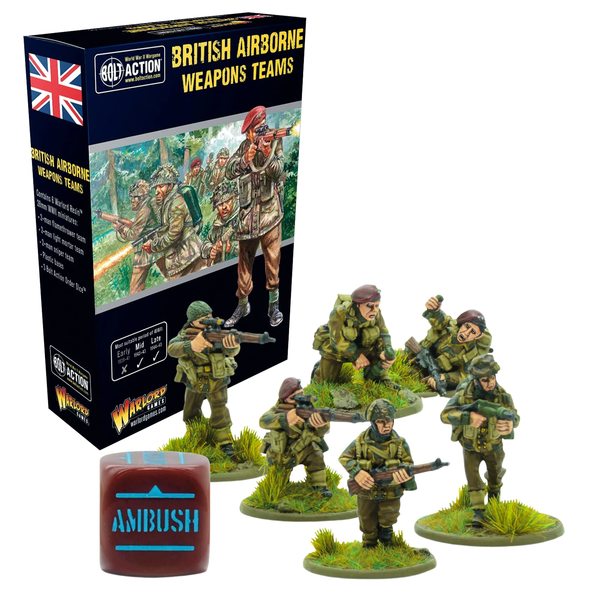
Infantry weapons teams are a key component of any Bolt Action army, providing as they do great tactical flexibility for your force. Sniper teams, anti-tank teams and flamethrower teams are among the most prevalent, presenting your opponent with multiple challenges to overcome. British forces were armed with 2-inch mortar for close support purposes. Two men were needed to operate it. An NCO was responsible for carrying and firing the weapon while the other carried ammunition. Weighing less than 11Ibs and offering an effective range of 500 yards, these mortars were quick to manoeuvre and deploy as needed. Snipers were armed with a SMLE No.4 Rifle equipped with a No.32 Mk.1 telescopic sight. The team carried fifty rounds of ammunition, five tracer round and fiver-armour-piercing rounds. Two No.36 Mills bombs or two No.77 smoke grenades were also carried, along with binoculars and a camouflage net. The portable flamethrower available to British forces was the Ack Pack. At a weight of 64Ibs, the Ack Packs could be carried and operated by one man. Fully loaded, the Ack Pack was capable of ten bursts each of a two second duration. With a range of fifty yards it was a truly fearsome weapon that excelled in clearing bunkers and buildings. Contains the following Warlord Resin Plus™ figures: 2-man Light Mortar team 2-man Sniper team 2-man Flamethrower team These figures are cast in our new and improved Warlord Resin Plus™. For more information on this material click here Models supplied unassembled and unpainted
£16.00 £14.40
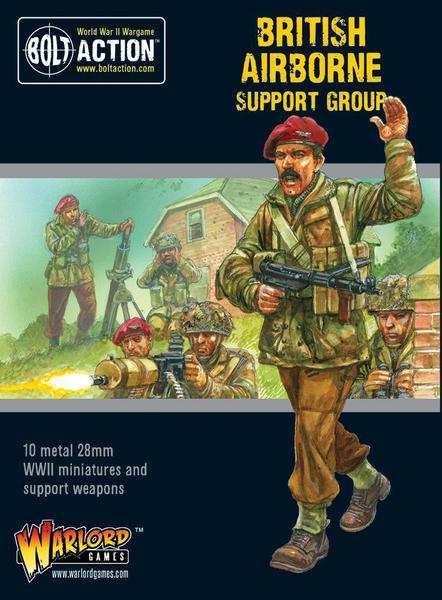
This set contains: 1 x British Airborne HQ 1 x Field Medic 1 x British Airborne Medium Machine Gun Team 1 x British Airborne Medium Mortar Team HQ The middle ranks of officers were almost invariably drawn from the upper-middle classes: educated in the public schools, instilled with the values of empire, and imbued with a sense of confidence, duty and resolve that is difficult to conceive of today. An officer unit consists of the man himself and can include up to two other men acting as his immediate attendants.Field Medic The field medic presents the wounded soldier with his best chance of surviving serious injury and can ensure those lightly wounded soldiers are returned to fighting fitness as rapidly as possible.Medium Machine Gun Team A .303 Vickers water-cooled machine gun offered fire support to infantry units. This was another weapon of World War I vintage that soldiered on through World War II and beyond, proving extremely effective at laying down continuous fire over a long range. A typical team consisted of a lance corporal gunner, a loader and an ammunition bearer.Medium Mortar Team The 3-inch mortar was used to provide support from up to 3,000 yards dependent upon the projectile used. The 3-inch mortar was operated by a crew of 3.Models supplied unassembled and unpainted
£29.50 £26.60
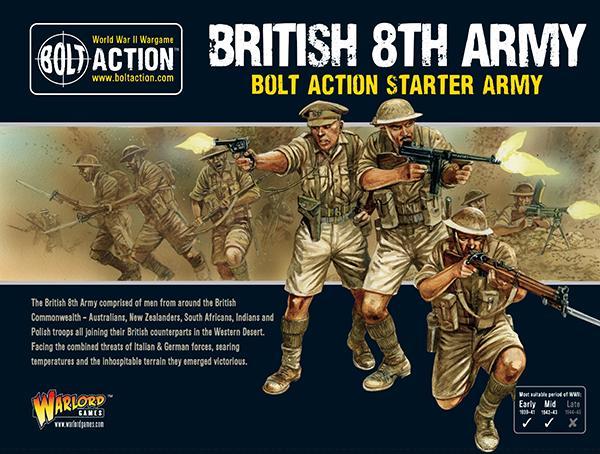
Formed from the Western Desert Force in 1941, the British 8th Army comprised men from across the British Commonwealth - British, New Zealanders, Australians, Indians and South Africans. Following early successes against the Italians in North Africa, the 8th Army suddenly faced a new, more deadly foe - the Deutsches Afrika Korps led by their mercurial commander, Erwin Rommel. Thus began a series of operations with Allied and Axis forces being pushed back hundreds of miles only to regain that territory and more with battles at El Alamein, Tobruk and Beda Fomm becoming legendary. With the Allied victory in North Africa the fighting soon encompassed Tunisia and then the very heartland of Italy itself. Struggling against the oppressive daytime heat, choking dust and freezing cold nights in addition to battling their German and Italian opponents the 8th Army become more popularly known as the 'Desert Rats' - a nickname adopted from the 7th Armoured Division, a key component of the Western Desert force. This boxed set contains a multitude of parts and options allowing you to field soldiers as diverse as British, Sikh, Punjabi, Mosselman or Scottish. Just the job to tackle Rommel's Afrika Korps or Mussolini's Italians! British 8th Army contains: Enough plastic components to make 30 British Commonwealth miniatures. Includes a host of options to allow for different weapon configurations and command models. Equipment included: Lee Enfield rifle, Thompson submachine gun, Bren gun LMG, Boys anti-tank rifle, Webley pistol and 2-inch mortar. Plastic bases. Construction leaflet. Optional Indian (Sikh, Punjabi and Yusufzai) and Scottish Highlander heads. Models supplied unassembled and unpainted
£33.30
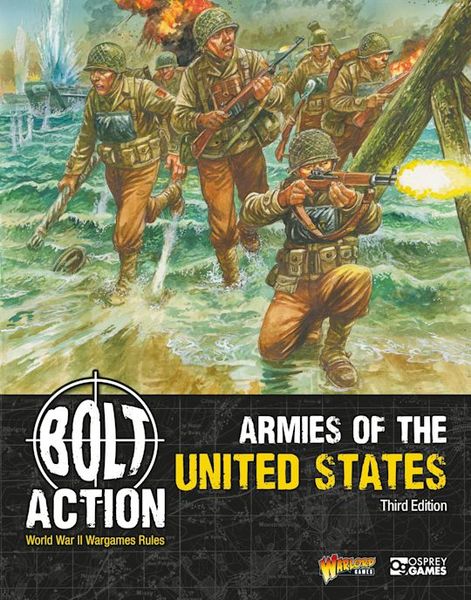
Armies of the United States: Third Edition is your essential guide to collecting and playing American forces in Bolt Action! With a huge variety of infantry, artillery, vehicles, and more covered across 112 full-colour pages, Armies of the United States gives you everything you need to transform your collection of US miniatures into a mighty fighting force on the Bolt Action tabletop. The vast arsenals of freedom stand ready for your command, and this book lets you bring them to the table! In addition to the unit profiles and national special rules, Armies of the United States is packed with historical background and full-colour illustrations and photography, giving you all the inspiration you need to create a truly unique American collection.
£28.00 £25.20
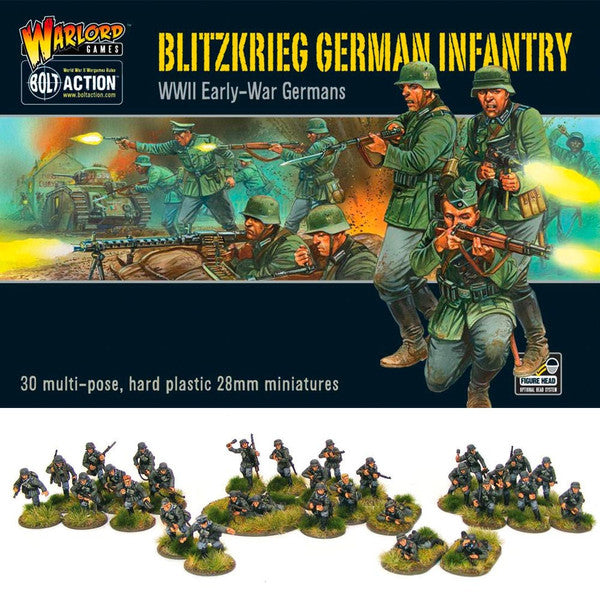
Representing the classic image of the German infantryman during World War II, these miniatures are equipped with knee-high jackboots, unadorned 'coalscuttle' helmet and a martial discipline that took them to almost complete dominance of mainland Europe. Whilst the glory often went to the armoured knights of the panzer divisions, the infantry were the spine of the Wehrmacht. Germany's cunning use of Blitzkrieg tactics conquered Poland, swept through the Low Countries and defeated France, before turning their attention to the Soviet Union. Soviet forces were pushed all the way to Moscow as the relentless march of Hitler's landsers swept all before them. Well-led, superbly trained and equipped with the finest infantry weapons in the world, the German infantryman was a skilled and dangerous foe capable of thinking for themselves if needed, giving them a significant advantage over their foes. Vorwarts! Blitzkrieg German Infantry contains: Enough plastic components to make 30 German infantry miniatures - Including a host of options to allow for different weapon configurations and command models. Weapons included: Kar 98K rifle, MP38/MP40 sub-machine gun, Luger pistol, MG34 light machine gun, Kar 98K with attached bayonet, stick grenades, scoped Kar 98K rifle. Round plastic bases (25mm diameter). Construction leaflet. Models supplied unassembled and unpainted
£33.30

Armies of Italy: Third Edition is your essential guide to collecting and playing Italian forces in Bolt Action! With a huge roster of infantry, artillery, vehicles, and more covered across 96 full-colour pages, Armies of Italy gives you everything you need to transform your collection of Italian Bolt Action miniatures into a significant fighting force on the tabletop. Whether you’re fielding the Italian military as a part of the Axis, or post-Armistice, this book includes not one, but three army lists and sets of national special rules to cover all eventualities! In addition to the unit profiles and national special rules, Armies of Italy is packed with historical background details, and full-colour illustrations and photography, to inspire your hobby journey.
£28.00 £25.20
Subscribe to our emails