
Sign up for our newsletter
Subscribe to our emails

Queen Gimnax has ordered the reclamation of the northern lands. As a cartographer in her service, you are sent to map this territory, claiming it for the Kingdom of Nalos. Through official edicts, the queen announces which lands she prizes most, and you will increase your reputation by meeting her demands. But you are not alone in this wilderness. The Dragul contest your claims with their outposts, so you must draw your lines carefully to reduce their influence. Reclaim the greatest share of the queen’s desired lands and you will be declared the greatest cartographer in the kingdom. In Cartographers: A Roll Player Tale, players compete to earn the most reputation stars by the time four seasons have passed. Each season, players draw on their map sheets and earn reputation by carrying out the queen's edicts before the season is over. The player with the most reputation stars at the end of winter wins! —description from the publisher
£25.00 £22.50

In the quiet village of Ravenswood Bluff, a demon walks amongst you. During a hellish thunderstorm, on the stroke of midnight, there echoes a bone-chilling scream. The townsfolk rush to investigate and find the town storyteller murdered, their body impaled on the hands of the clocktower, blood dripping onto the cobblestones below. A Demon is on the loose, murdering by night and disguised in human form by day. Some have scraps of information. Others have abilities that fight the evil or protect the innocent. But the Demon and its evil minions are spreading lies to confuse and breed suspicion. Will the good townsfolk put the puzzle together in time to execute the true demon and save themselves? Or will evil overrun this once peaceful village? Blood on the Clocktower is a bluffing game with players on opposing teams of Good and Evil, overseen by a Storyteller player who conducts the action and makes crucial decisions. The goal of the game is to successfully deduce and execute the demons before they outnumber the townfolk. During a 'day' phase players socialize openly and whisper privately to trade knowledge or spread lies, culminating in a player's execution if a majority suspects them of being Evil. During a 'night' time, players close their eyes and are woken one at a time by the Storyteller to gather information, spread mischief, or kill. The Storyteller uses the game's intricate playing pieces to guide each game, leaving others free to play without a table or board. Players stay in the thick of the action to the very end even if their characters are killed, haunting Ravenswood Bluff as ghosts trying to win from beyond the grave. If you arrive late to a game, you can enter after it's started as a powerful Traveller character with unusual talents and questionable allegiances. Each character comes with their own special ability and no two players in a game are ever the same character.
£145.00 £130.50
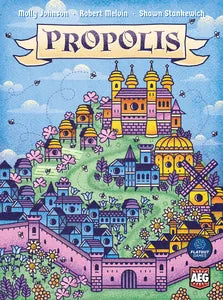
Propolis is a worker-placement, engine-building, area-control, and tableau-building game. Players take on the role of competing medieval bee colonies and take turns deploying worker bees to collect pollen, fortify their positions, and construct their hives to appease their queen and become the most glorious in the land! As bees compete over the realm's floral landscapes, they will be collecting pollen to create the propolis they need to build their hives. Attaining dominance in different realms provides additional glory and building materials. As hives expand, new structures provide additional resources, new scoring opportunities, and the prerequisites to construct a glorious palace for the queen. The player who dominates the realm and builds the most prestigious home wins.
£25.00 £22.50
The trick-taking game Wizard uses a sixty-card deck that consists of the traditional 52-card deck (1-13 in four suits) along with four Wizards (high) and four Jesters (low).Players compete over multiple rounds based on the number of players, and whoever ends with the highest score wins. In each round, players are dealt a hand of cards — one card in the first round, two cards in the second, three in the third, etc. — then trump is determined by flipping the top card of the undealt deck; if a suit is revealed, that suit is trump, while if the card turned up is a Jester, it is turned down and there is no trump for that round. If the card turned up is a Wizard, the dealer chooses one of the 4 suits as the trump suit. The dealer cannot choose "no trump". On the last round of each game all cards are dealt out so there is no trump. Players then state how many tricks they expect to win in the round.The playing and winning of the tricks uses mostly standard trick-taking rules. If a player leads a suited card, then all other players must follow suit, if possible. If a player leads a Jester, then the second player determines the suit led. If a player leads a Wizard, then those who follow can play whatever they want. However, in all cases a player may always play a Wizard or Jester, even if they hold cards in the suit led.After each player has played a card, determine the winner of the trick as follows: If one or more Wizards were played, the player of the first Wizard wins the trick, collects the cards, and leads to the next trick. If not, whoever played the highest trump wins the trick. If not, whoever played the highest card of the suit led wins the trick. If all players played Jesters, whoever played the first Jester wins.After all tricks have been played, players tally their score for the round. If a player matched their bid, winning exactly as many tricks as stated at the start of the round, they score 20 points, plus 10 points for each trick taken. If a player missed their bid, they lose 10 points for each trick that they were off, whether they took more or fewer than predicted.A common variant in Wizard is to not allow the total number of tricks bid in a round to match the round number, thereby forcing (at least) one player to be off each round.
£10.00
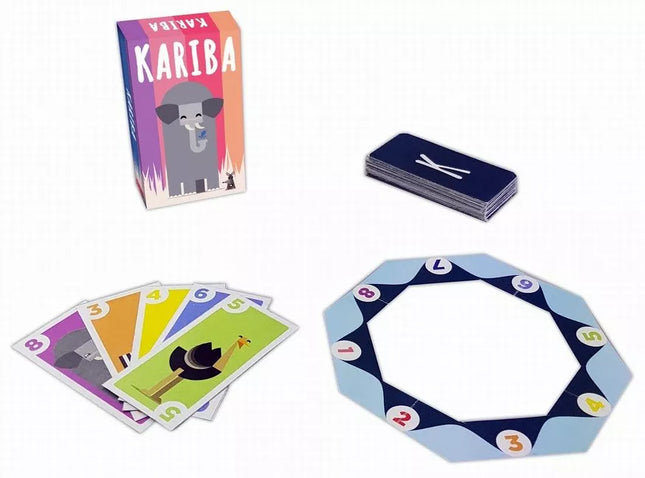
All animals are thirsty after an adventurous day in the savannah, so they've all trekked to the drinking grounds. Every animal wants to be the first to drink, but watch out! The elephant scares the rhino, the rhino scares the ostrich, and the ostrich scares the zebra. Anything can happen... The mice might even scare the elephant! The player who scares away the most animals wins.To set up Kariba, shuffle the cards and deal five to each player, placing the remainder face down as a deck. Place the game board in the center of the table.During a round, a player lays down one or more cards of the same animal, placing the cards in the corresponding position (1-9) around the lake.If at least 3 cards of the same animal are placed in front of the lake, then these animals scare weaker animal(s) (closest lower number) while they are drinking. The player picks all the cards from the weaker animal off the board and puts them face down in front of her/him. Each card is worth 1 point, and whoever has the most points wins.
£11.99 £10.80
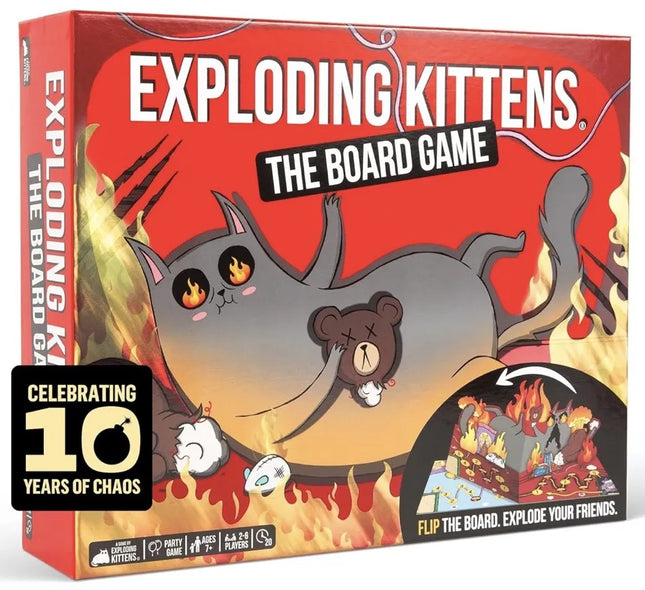
There's never been a board game like this before! Your goal is to make it to the end of the board without landing on the Exploding Kitten. To do that you'll play cards and plot strategies to sabotage your opponents. But don't get too cocky because one wrong move can cause the board to flip. This completely transforms the board to reveal a new path where every move could be your last. You have to think fast, form alliances, play smart, and avoid the Exploding Kittens at all costs.The stakes are high but the rules are simple… Just beware, danger, and betrayal, and pee your pants laughing moments lurk around every corner.What other game lets you play as a TacoCat, SushiCat, or GnomeCat? Who else would give you the power of Meatpants, a Litterbox Sandworm, or a Butterfly Punch?—description from the publisher
£25.00 £22.50
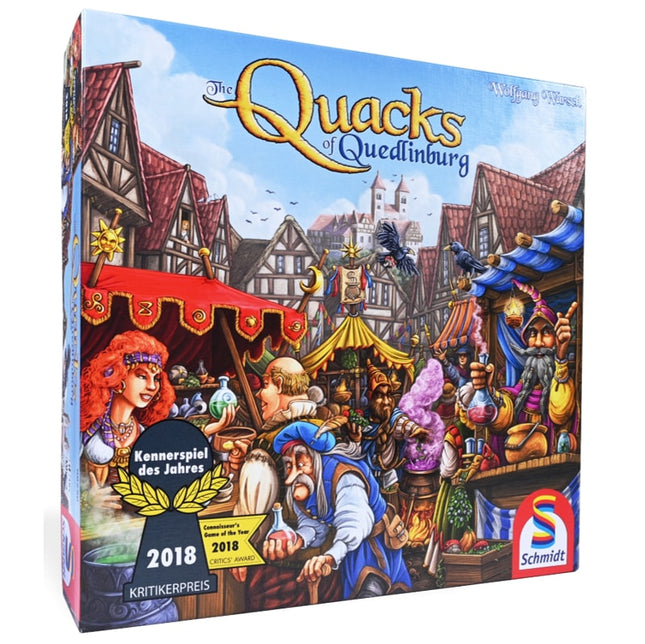
In The Quacks of Quedlinburg, players are charlatans — or quack doctors — each making their own secret brew by adding ingredients one at a time. Take care with what you add, though, for a pinch too much of this or that will spoil the whole mixture!Each player has their own bag of ingredient chips. During each round, they simultaneously draw chips and add them to their pot. The higher the face value of the drawn chip, the further it is placed in the swirling pattern. Push your luck as far as you can, but if you add too many cherry bombs, your pot explodes!At the end of each round, players gain victory points and coins to spend on new ingredients to add to their bags, depending on the strength of the ingredients in their pots. But players with exploded pots must choose points or coins — not both! The player with the most victory points at the end of nine rounds wins the game.
£44.00 £39.60
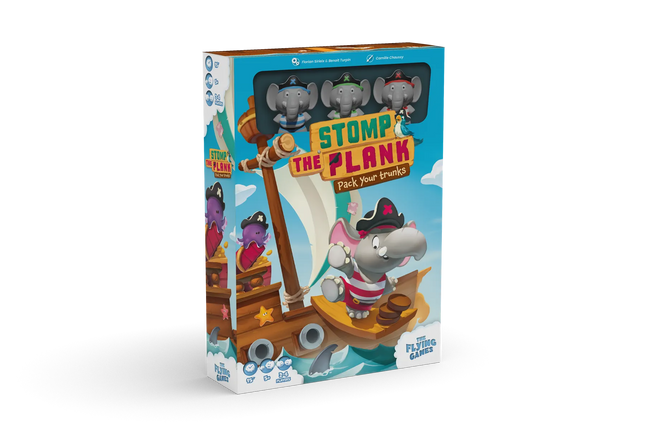
You are young and mischievous pirates. Try to steal treasures from captain Giraffe’s chest while accusing your fellow pirates. But be careful because if you get caught, you’ll walk the plank! For each treasure you manage to steal, your opponent will end up with a crate at the end of their plank...which might just tip over... The first one to fall loses the game!Each turn, draw as many cards as you want from the captain's chest. The more you draw, the more crates your opponents will place on their planks. But be careful, if you draw the same card twice, your elephant will stomp forward on your plank.—description from the publisher
£29.00 £26.10
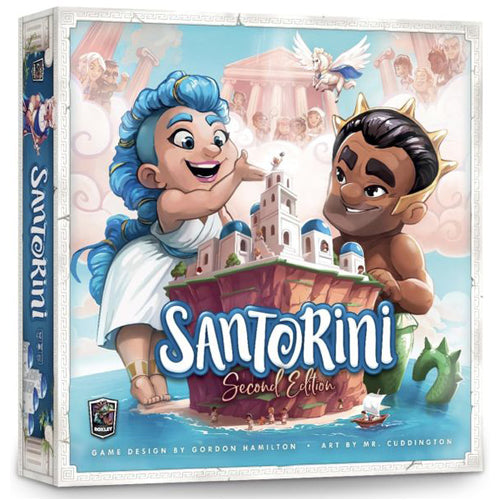
Santorini is an accessible strategy game, simple enough for an elementary school classroom while aiming to provide gameplay depth and content for hardcore gamers to explore, The rules are simple. Each turn consists of 2 steps: 1. Move - move one of your builders into a neighboring space. You may move your Builder Pawn on the same level, step-up one level, or step down any number of levels. 2. Build - Then construct a building level adjacent to the builder you moved. When building on top of the third level, place a dome instead, removing that space from play. Winning the game - If either of your builders reaches the third level, you win. Variable player powers - Santorini features variable player powers layered over an otherwise abstract game, with 40 thematic god and hero powers that fundamentally change the way the game is played.
£48.00 £43.20
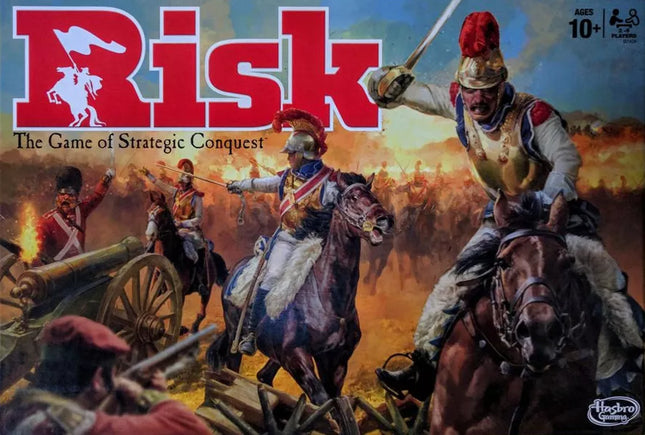
Possibly the most popular, mass market war game. The goal is conquest of the world. Each player's turn consists of:- gaining reinforcements through number of territories held, control of every territory on each continent, and turning sets of bonus cards.- Attacking other players using a simple combat rule of comparing the highest dice rolled for each side. Players may attack as often as desired. If one enemy territory is successfully taken, the player is awarded with a bonus card.- Moving a group of armies to another adjacent territory
£41.00 £36.90

In Kingdomino, you are a lord seeking new lands in which to expand your kingdom. You must explore all the lands, including wheat fields, lakes, and mountains, in order to spot the best plots, while competing with other lords to acquire them first.The game uses tiles with two sections, similar to Dominoes. Each turn, each player will select a new domino to connect to their existing kingdom, making sure at least one of its sides connects to a matching terrain type already in play. The order of who picks first depends on which tile was previously chosen, with better tiles forcing players to pick later in the next round. The game ends when each player has completed a 5x5 grid (or failed to do so), and points are counted based on number of connecting tiles and valuable crown symbols.
£21.99 £19.80
Dungeon Mayhem: Battle for Baldur’s Gate unleashes two brand new characters from Baldur's Gate: beloved ranger Minsc with his miniature giant space hamster Boo and the shapeshifting druid Jaheira.
£11.00 £9.90
Subscribe to our emails