
Sign up for our newsletter
Subscribe to our emails

In Hummingbirds, you'll guide your birds to claim flowers that hide sand timers, then reveal those timers to check for nectar. If the sand timer has run out, collect a nectar token of the same color. The longer you wait, the sweeter the reward! But be careful: if the sand timer is still ticking when you check, you'll lose one of your lowest-value nectar tokens. —description from the designer
£29.99 £27.00

Squishmallows Fans Rejoice: Introducing the official Squishmallows game, Take4! It's action-packed fun for players of all ages, adults and kids alike. Ages 8+: This game for social gatherings is intended for players 8 years and older. Perfect to play with your middle schooler, your nieces and nephews, or best friends. Exclusive Plush Benny The Bigfoot Squishmallows: Contains an exclusive version of Benny The Bigfoot with a fun new hat. Cute, right? Includes 1 Exclusive Squishmallows, 84 Cards, and Instructions
£20.00 £18.00

Flamme Rouge BMX is a nail-biting racing game. Players race on their BMX-bikes around the local backyard to be the first over the goal line, but it's not a Sunday stroll! This is a tight race over one round where you jump over ramps, skid over gravel, and press on when thunder strikes. Oh, and pace yourself! If you keep pushing your limits, you might have to catch your breath while others swoop by. —description from the publisherSimilar spin to the original version of the game, but this time aimed at the younger audience.
£29.00 £26.10
Pusheen is an easy-to-learn, fast-paced and fun dexterity game for all the family. Flip a card, grab your character meeples, and get building! The quickest player will win the stacking race! Increase the fun with hilarious team rules!This game is based on Kittin, but with a few tweaks.
£12.60

Legend has it that the old mansion on the outskirts of the city is home to a fabulous treasure! Hoping to find it, you decide to spend the night there. You are about to give up when the ghost of Captain Echo appears to help you find his treasure. He isn’t much of a talker, but he plays a mean tambourine, and he’s going to use it to tell you which rooms to search in!Players cooperate to find Captain’s treasure before the moon has traveled across the sky and the night is over. Each round, one player becomes the Ghost of Captain Echo. The Ghost must use a tambourine to give clues that help the other players guess the correct Noise card. If they do, they get to reveal a piece of the Captain’s treasure.—description from the publisher
£28.99 £26.10
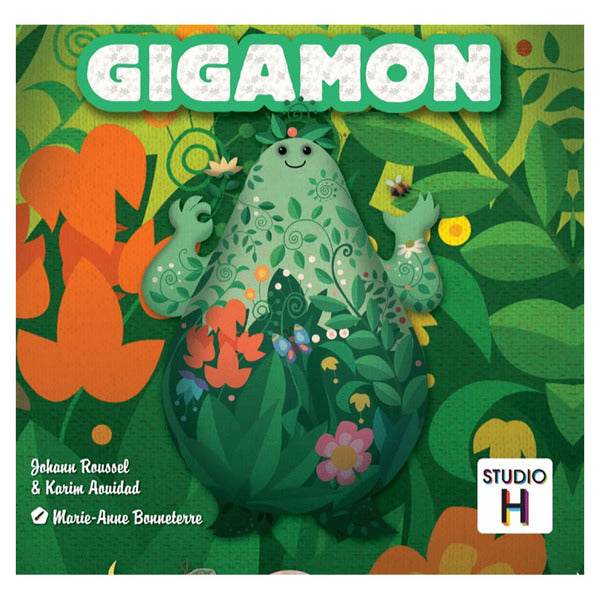
Gigamons is a game for 2 to 4 players from 5 years old.This is the last event to enter the guild of magicians. It remains the ultimate lesson to master: the invocation of Gigamons. After this test, one that will catch more Gigamons be promoted to Elemage. Good luck and good luck to all!Aim of the gameFind the pairs Elemons to the exchange against Gigamons.Setting up of the game:1-Mix all the Elemons tiles face down and create a 3 by 3 square!2-Place the 7 Gigamons and the Rocks tiles on the side of the play area.3-The remaining Tiles of Elemons form the deck.How to play?The youngest begins.In turn, each player returns 2 face tiles.If the tiles are different, the player puts the face down (Polymon always forms a pair with any elemon)If the tiles are identical, the player wins and triggers the power the Elemon that is drawn (see specials ability of each Elemons. Then he replaces them 2 tiles from the deck without looking at them. If a player has 3 identical Elemons, it can put them back in the box to catch the Gigamon associate. If an opponent already has this Gigamon, he can steal it.Then it was the turn of the next player.Elemon powers:Polymon: Functions as a wild, always forming a pair with any elemon.Floramon: The player takes a tile from the top of the draw pile and adds it to their group of tiles.Aeromon: Swap one of the tiles in front of you with a tile in front of another player. The player who gets the ability gets to choose which tiles are swapped.Pyromon: Choose a tile in front of another player and remove it from the game.Hydromon: While everyone else closes their eyes, look at four of the tiles in the 3X3 grid and then turn them back over.Geomon: Place a rock tile on one of the tiles in the 3X3 grid. No player may pick up the tile underneath the rock until the player who played it takes their next turn.Electromon: The player gets an extra turn.End of the gameThe game ends in 2 ways:When a player has caught 3 Gigamons;When the Elemons tiles deck is empty.Who win the game?Who ever has the most Gigamons is promoted to Elemage!In case of tie, who ever has the most Elemons wins.In case of a tie, all tied players are promoted to Elemages.
£18.00
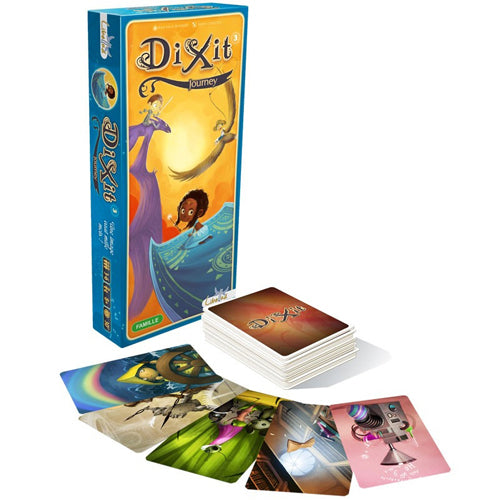
As with Dixit: Quest, Dixit 3 is an expansion for Dixit with 84 new cards that feature fantastic and surrealistic artwork. These cards can be used with the components of the base game to provide more variety or used to play the Dixit game on their own. (Dixit 3 includes no scoring board or tokens, so you'd need to track such things and create your own voting tokens.)As for the game play in Dixit, each round one player takes on the role of Storyteller, choosing one card from his hand, then telling a story, singing a ditty or otherwise doing something that in his opinion is associated with the played card. Each other player then chooses one card in her own hand and gives it to the Storyteller in secret. These cards are shuffled and revealed, then players vote on which card was played by the Storyteller. If no one or everyone votes for the Storyteller, then he receives no points; if he received some votes but not all the votes, he scores based on the number of votes received. Each player who submitted a correct vote or who received a vote on her card submission also scores. After a certain number of rounds, the player with the most points wins.Similar to: Dixit: Journey – In the U.S. and Australia, the cards included in Dixit 3 will be packaged into a standalone game titled Dixit: Journey and not sold as an expansion.
£20.99 £18.90

A cooperative family board game where you and your fellow Ninja will go on thrilling adventures - facing serpents, pirates… and even a bewildered postman. In the game, Villains are attacking the great ship Destiny’s Bounty, and the Ninja must defend their ship! To defeat the Villains, you must unlock your Ninja potential. Upgrade your skills and work together with your fellow Ninja using your unique abilities to thwart the Villains' plans to conquer the ship.
£34.99 £31.50

Zombies are attacking the entire town! Cooperate with your friends and launch an expedition to drive off the overwhelming hordes. Collect the four ingredients, and brew the antidote that will save the world! Zombie Teenz Evolution is the sequel to Zombie Kidz Evolution (#1 Kids' Game on BGG). It is a standalone game with a different set of rules, so you don’t need to have played the first game to jump into the second. The rules are slightly more advanced and will require a little more strategic thinking. Zombie Teenz Evolution follows the same general guidelines as its predecessor: a fast and simple game whose rules evolve from game to game through the opening of 14 "mystery" envelopes. By accomplishing special missions, players unlock additional content that will provide a richer experience, while constantly renewing the enjoyment of the game. The icing on the cake: the two games are compatible! You will be able to play Zombie Kidz with your Zombie Teenz, and vice versa!
£26.00 £23.40

Jump into Super Mario™ Labyrinth! Mario, Luigi, Donkey Kong and many other important characters from Nintendo Super Mario games are hiding in the labyrinth. Search for them before it's too late! Be the first to find all your characters by shifting the walls of the labyrinth to create a clear path. Players take turns to search the Labyrinth for their characters by carefully moving through the constantly changing maze. The character cards are divided between the players, without revealing them to the other players. The maze cards are randomly placed on the playing board and the first player uses the extra card to start moving the first wall. It is up to you to strategically move the walls so you can collect your Mario whilst blocking the path for the other players. This game is full of magical and addictive family fun. This item includes 1x Game board, 34x Maze cards, 24x Treasure cards, 4x playing pieces, 1x Set of Instructions. This game is suitable for 2-4 players. Suitable for ages 7 years and up. Fully complies with all necessary UK and EU testing standards. Ravensburger are one of the largest board game manufacturers, with millions of games sold worldwide. Our family games make ideal gifts for boys and great gifts for girls. Great replay value - navigating through labyrinth's ever-changing maze is different every time you play, meaning it can be played over and over again.
£28.00 £25.20

The well-known sliding game becomes a highlight for all computer game fans and families on game night with this Minecraft edition. In this Minecraft maze, nothing stays in its place because the walls and corridors are constantly moving! Who can move the corridors so that new paths are created and the world can be explored and discovered? Simple rules and fun for 2-4 players aged 7and up!Ravensburger are one of the largest board game manufacturers, with millions of games sold worldwide. Our family games make ideal gifts for boys and great gifts for girls. Perfect toys for your child – Games for kids of every age help support a child’s development as they play, building skills such as concentration and creativity. Great replay value - navigating through labyrinth's ever-changing maze is different every time you play, meaning it can be played over and over again.
£28.00 £25.20

The iconic family game for 2-4 players aged 7 and up delights kids and adults alike and is a must-have for any game collection. Some of the most famous Pokémon are hiding in this crazy Labyrinth. With popular Pokémon such as Pikachu, Bulbasaur, Charmander, and Squirtle, players must skillfully move the paths in this simple strategy game to collect other Pokémon. At the end, the player who has captured the most Pokémon in this board game wins!Some of the most famous Pokémon have been hiding in this crazy maze. With the popular Pokémon such as Pikachu, Bulbasaur, Charmander and Squirtle, players have to move the paths so skillfully in this simple strategy game that they can collect other Pokémon.At the end of the day, if you catch the most Pokémon in this board game, you win! Be the first to find all your characters by shifting the walls of the labyrinth to create a clear path. Players take turns to search the Labyrinth for their characters by carefully moving through the constantly changing maze. The character cards are divided between the players, without revealing them to the other players. The maze cards are randomly placed on the playing board and the first player uses the extra card to start moving the first wall. It is up to you to strategically move the walls so you can collect your Pokemon whilst blocking the path for the other players. This game is full of magical and addictive family fun. This item includes 1x Game board, 34x Maze cards, 24x Treasure cards, 4x playing pieces, 1x Set of Instructions. This game is suitable for 2-4 players. Suitable for ages 7 years and up. Fully complies with all necessary UK and EU testing standards. Ravensburger are one of the largest board game manufacturers, with millions of games sold worldwide. Our family games make ideal gifts for boys and great gifts for girls. Great replay value - navigating through labyrinth's ever-changing maze is different every time you play, meaning it can be played over and over again.
£28.00 £25.20
Subscribe to our emails